
A comprehensive new report from William & Mary’s AidData research lab has uncovered the vast scale of China's international financial activities, revealing a portfolio of $2.2 trillion in loans and grants distributed across 200 countries. This figure is significantly larger than any previous public estimates, suggesting a global economic influence that has been widely underestimated.
The research, detailed in the publication “Chasing China: Learning to Play by Beijing’s Global Lending Rules,” marks a pivotal moment in understanding global finance. It highlights a strategic shift in Beijing's lending, with a growing focus on developed, high-income nations for investments in critical infrastructure and technology.
Key Takeaways
- A new report from AidData reveals China's global lending and grant portfolio totals $2.2 trillion.
- This amount is two to four times larger than previously understood, covering projects in 200 countries.
- More than 75% of China's overseas lending is now directed towards upper-middle and high-income countries.
- Investments in wealthy nations, including the U.S. and E.U., target critical infrastructure, minerals, and high-tech assets.
Unprecedented Financial Scope Revealed
The latest data from AidData presents a dramatic reassessment of China's role as a global creditor. The $2.2 trillion total provides a new benchmark for economists and policymakers tracking international capital flows. According to the researchers, previous analyses failed to capture the full extent of Beijing's financial dealings.
"The overall size of China’s portfolio is two to four times larger than previously published estimates suggest," said Brad Parks, the executive director of AidData and the report's lead author. This discrepancy stems from the complex and often secretive nature of the lending arrangements, which the research lab worked to uncover through extensive data collection.
The effort, which involved contributions from William & Mary students, compiled a massive dataset that for the first time includes detailed information on financial activities in high-income countries, offering a more complete picture of China's global strategy.
A Strategic Pivot to Developed Nations
One of the most significant findings in the report is the clear pivot in China's lending strategy. While historically focused on developing countries, the data shows that more than three-quarters of China's overseas lending operations now support projects in upper-middle and high-income nations.
This shift indicates a strategic move to engage with the world's largest economies on a new level. The report details that these investments are not random but are highly targeted.
"Much of the lending to wealthy countries is focused on critical infrastructure, critical minerals and the acquisition of high-tech assets, like semiconductor companies," Parks explained.
This approach allows Beijing to secure access to essential resources and acquire stakes in industries that are foundational to future economic and technological leadership. The focus on high-tech assets, in particular, points to a long-term competitive strategy.
From Developing to Developed
Historically, China's international development finance, often associated with its Belt and Road Initiative, was primarily directed at low- and middle-income countries in Asia, Africa, and Latin America. This new data confirms a major evolution, where Beijing is now a significant financial player within the economies of its primary geopolitical and economic rivals.
Investment Footprint in the West
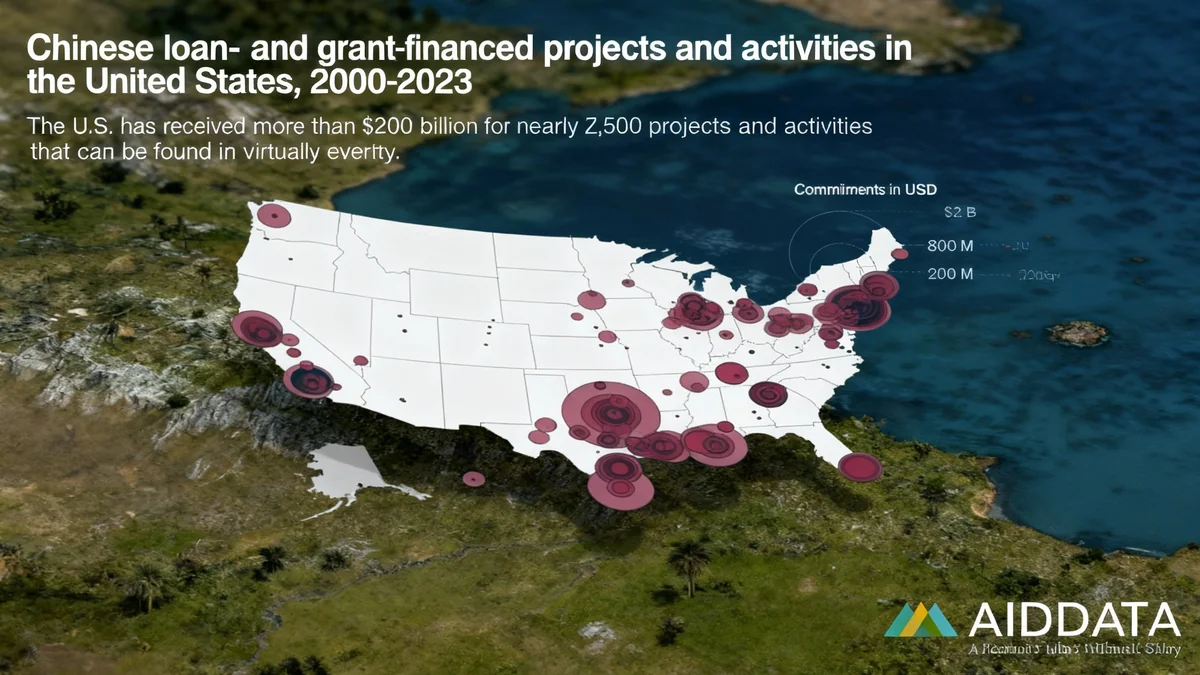
The report provides a detailed breakdown of China's financial activities within Western nations, revealing figures that may surprise many observers. The United States has been a major recipient of Chinese capital.
China's Financial Reach by the Numbers
- United States: Over $200 billion for nearly 2,500 projects.
- United Kingdom: $60 billion.
- European Union (27 member states): $161 billion for nearly 1,800 projects.
Within the European Union, the investments are widespread, with several key economies receiving substantial funds. Germany leads the list with $33.4 billion, followed by France at $21.3 billion and Italy at $17.4 billion. Other notable recipients include Portugal ($11.7 billion) and the Netherlands ($11.6 billion).
These projects are not limited to a few sectors but span across various industries, appearing in nearly every U.S. state and across the European continent. The breadth of these activities underscores the deep financial integration that has occurred over the last two decades.
Implications for Global Policy
The findings from the AidData report carry significant implications for international relations and economic policy. As Western governments reassess their economic relationships with China, this data provides a new, more accurate foundation for decision-making.
The scale of the lending suggests a level of economic interdependence that complicates geopolitical maneuvering. For high-income countries, understanding the extent and nature of Chinese investments within their borders is now a matter of national security and economic sovereignty.
The 300-plus page report serves as a critical resource for policymakers, researchers, and business leaders seeking to navigate the evolving global economic landscape. It underscores the importance of transparency in international finance and the need for a clear-eyed understanding of the rules governing global lending in the 21st century.