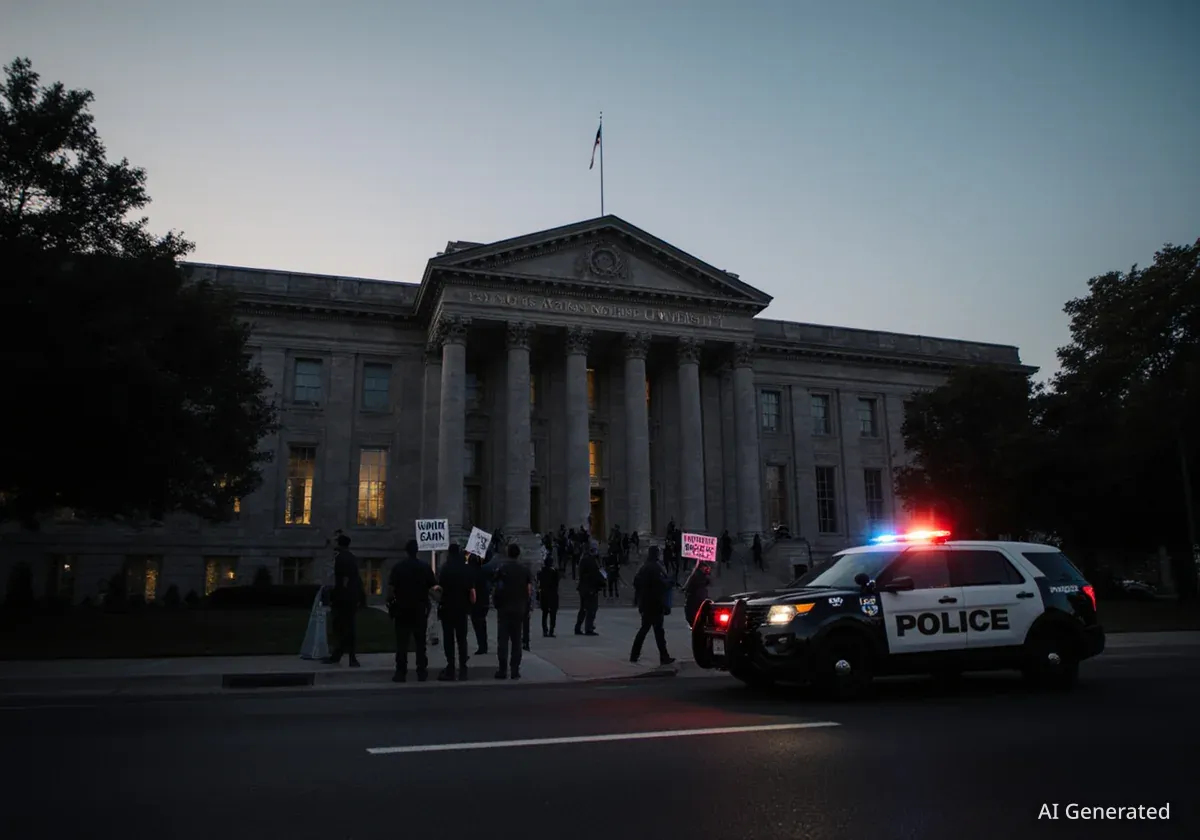


A student activist at Cal Poly Humboldt was arrested early Friday morning following a 14-hour occupation of a campus building. The arrest comes after at least three students, including the one taken into custody, received interim suspensions barring them from university property.
The events stem from a pro-Palestine protest where students occupied Nelson Hall, demanding the university divest from entities tied to Israel. University officials maintain the disciplinary actions were a response to policy violations and safety concerns, not an infringement on free speech.
Key Takeaways
- A Cal Poly Humboldt engineering masters student, Rick Toledo, was arrested on suspicion of battery, assault, conspiracy, and false imprisonment.
- At least three students have been placed on interim suspension, preventing them from accessing campus, attending classes, or going to their on-campus jobs.
- The university alleges Toledo assaulted a staff member to gain entry into the occupied building, a claim he denies.
- Faculty members have raised concerns about the university's disciplinary process, questioning the lack of due process in interim suspensions.
- The university states that while it supports free speech, the occupation of a building constituted trespassing and created safety issues.
Arrest Follows Building Occupation and Suspension
Rick Toledo, an engineering masters student and organizer with Students for a Democratic Society, was arrested by University Police at 1 a.m. Friday. His arrest followed the university placing him and at least two other students on interim suspension on Monday. The suspension notice effectively bans them from campus under threat of arrest.
The charges Toledo faces, according to booking records, include suspicion of battery, assault, conspiracy, and false imprisonment. These allegations appear connected to an incident during the occupation of Nelson Hall. A workplace violence restraining order, granted temporarily by a judge, accuses Toledo of physically blocking a university official.
Conflicting Accounts of the Altercation
The court filing alleges that Toledo “aggressively walked up to Mr. Moore, spread his arms wide making a ‘T’ with his body, backed Mr. Moore against the wall, and pinned him there” to allow other protesters into the building. The official was identified as Michael Moore, an associate director at the student activities center.
Toledo refutes this characterization of the event. Speaking before his arrest, he denied any assault occurred.
“Assault means I had to threaten that person. I had to actually have some kind of physical contact where I was harming them. None of that actually happened,” Toledo stated. He claims he stood with his back turned and arms out, did not make physical contact, and that the staff member was free to leave.
As of Friday, formal criminal charges related to the arrest had not yet been filed in court.
Financial and Academic Impact
Toledo, who works on campus as an instructional aide, stated the suspension has severe consequences. “I live paycheck to paycheck, and it’s really harmful to me financially,” he said. With this being his final semester, he expressed concern that the suspension could prevent him from completing his degree.
University Cites Safety and Policy Violations
Cal Poly Humboldt officials have defended their actions, drawing a line between permissible protest and unlawful activity. A university spokesperson, Aileen Yoo, stated that while the university cannot discuss specific student cases due to privacy laws, the occupation of Nelson Hall crossed a boundary.
“They took over a space not intended for that purpose and not considered a public space, and they restricted access to the space, calling into question the safety of those inside and others in the building,” the university said in a statement. “It went from a free speech activity to trespassing.”
The university emphasized that protesters were given multiple verbal and written requests to leave over the 14-hour period. In court declarations, university officials expressed fear for their safety. Yoo stated she felt “incredibly unsafe” due to shouting and the “intimidating presence of the masked protestors.” Moore similarly declared he was concerned for his safety, “given that Mr. Toledo so brazenly assaulted me in broad daylight.”
Preventative Campus Measures
In anticipation of further protests on Thursday, university officials locked down Siemens Hall, a separate campus building. This action forced the relocation of classes and the closure of offices. An email to faculty cited potential disruptions from a planned protest as the reason for the closure.
Concerns Over Due Process and Free Speech
The university’s response has drawn criticism from some students and faculty, who argue the disciplinary measures are disproportionate and lack due process. Students gathered outside the courthouse on Friday to protest Toledo's arrest.
“It’s way out of proportion for a peaceful sit-in,” said Kiera Sladen, a student at the protest. “It’s important to stand up for anyone who has a cause, because otherwise we could see a backsliding of the First Amendment.”
Faculty members have also voiced concerns. Gabi Kirk, an assistant professor of geography, described the university's interim suspension process as “opaque.”
“Interim suspension requires one administrator, the president or the president proxy, to declare that an individual is a reasonable threat to campus safety and property,” Kirk explained. She argued the process should only be used for individuals who pose a direct threat and noted that protest-related suspensions in the past have left students without housing and jobs before any formal finding of wrongdoing.
Toledo and the other suspended students are being advised by Palestine Legal. Toledo’s student conduct conference is scheduled for March 13, and a hearing for the workplace harassment restraining order is set for March 25. He has stated his intention to fight the accusations.