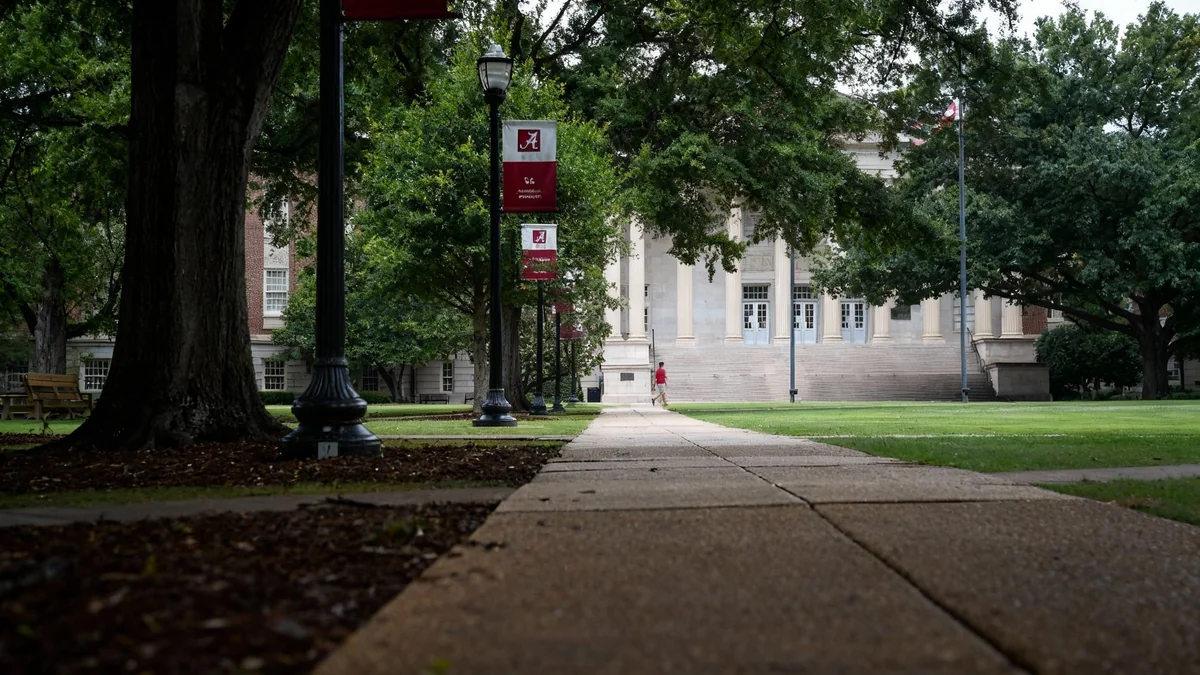
A recent national report on free speech has given four major public universities in Alabama low grades, raising questions about the environment for open expression on their campuses. The 2026 College Free Speech Rankings, compiled by the Foundation for Individual Rights and Expression (FIRE), assigned the state an overall grade of D, with the University of Alabama's Tuscaloosa campus receiving the lowest score among the group.
The rankings are based on surveys of tens of thousands of undergraduate students nationwide and also consider specific incidents that impact free expression. The report highlights a challenging climate for students and faculty to voice their opinions without fear of reprisal, reflecting a broader national trend where a majority of ranked institutions received failing grades.
Key Takeaways
- Alabama's public universities received an overall 'D' grade for their free speech environment in a 2026 national report.
- The University of Alabama in Tuscaloosa ranked lowest in the state at No. 89 nationally with a 'D-' score.
- Auburn University was the highest-ranked Alabama school at No. 28, though it still received a 'D+' grade.
- The report cited specific incidents, including the non-renewal of an adjunct professor's contract at UA over a social media post.
- University officials maintain their commitment to upholding First Amendment rights and fostering open dialogue on campus.
Statewide Rankings Reveal Concerns
The comprehensive report evaluated 257 colleges across the country, with Alabama's institutions falling in the lower half of the rankings. The state's overall score was 63.9 out of a possible 100, representing a slight decline from the previous year's report.
The individual school rankings within Alabama show a range of performance, though all received a grade of D+ or lower:
- Auburn University: Ranked No. 28 with a score of 69.03 (D+)
- University of Alabama at Huntsville (UAH): Ranked No. 46 with a score of 64.11 (D)
- University of Alabama at Birmingham (UAB): Ranked No. 54 with a score of 62.97 (D)
- University of Alabama (Tuscaloosa): Ranked No. 89 with a score of 59.56 (D-)
Sean Stevens, FIRE’s Chief Research Advisor, explained that the report aims to capture the "pulse on what the climate is like on these different campuses for freedom of speech for undergraduate students." The data was gathered from survey responses of approximately 68,000 students nationally, including about 4,400 from Alabama.
National Context
Nationally, the report paints a concerning picture. Of the 257 schools ranked, 166 received a failing grade (below 60 points), and another 64 were in the D range. Claremont McKenna College in California received the top ranking, while Barnard College in New York was ranked last.
Incidents at the University of Alabama
The report specifically highlighted two incidents at the University of Alabama's main campus that influenced its low score. These events have drawn attention to how the administration handles contentious speech from both faculty and students.
The Case of an Adjunct Professor
One major factor was the university's decision not to renew the contract of adjunct faculty member Jennifer Collins. The action followed a social media post she made regarding the assassination attempt on a former president in July 2024. Collins stated that she removed the post at the request of a university administrator, but not before a student had captured it and discussed it on TikTok.
FIRE intervened by sending a letter to the university's then-president, Stuart Bell, advocating for Collins' reinstatement. The letter argued for her constitutional protections.
"The First Amendment protects faculty when speaking as private citizens on matters of public concern," the letter stated.
Collins reported that despite her qualifications, she has since been unable to find employment at the university. This type of administrative response to faculty speech is a growing concern for free speech advocates.
A Conservative Student Group's Policy Change
Another incident involved the University of Alabama's chapter of the Young America’s Foundation (YAF). The conservative student group sought to amend its anti-discrimination policy to remove gender identity. The university initially resisted the change, but the student organization was ultimately successful.
Trenton Buffenbarger, the YAF chapter president, confirmed that the group has not faced further issues and has even invited opposing viewpoints to its meetings. He noted a rise in political awareness and student involvement on campus following recent national events.
Universities Respond to Rankings
In response to the report, officials from several of the universities emphasized their dedication to free speech principles. They pointed to the thousands of events and discussions that take place on their campuses as evidence of an open environment.
Official Statements on Free Speech
Alex House, associate communications director for the University of Alabama, noted that the university approved 3,700 registered, content-neutral events in 2025. "The University of Alabama is committed to free and open inquiry and expression for members of the University campus community," House said.
Similarly, UAB's public relations director, Alicia Rohan, affirmed the university's commitment to the First Amendment, stating, "College campuses historically are a place where different opinions are exchanged, which has great intellectual development value."
Kristina Hendrix, UAH's vice-president for strategic communications, echoed these sentiments, saying the school is "dedicated to safeguarding free speech, academic freedom and the educational experience of our students."
Broader Implications and Unseen Pressures
While the rankings provide a snapshot based on student surveys and public incidents, some argue they don't capture the full picture. Sara McDaniel, president of the University of Alabama's chapter of the American Association of University Professors, suggested that the methodology should include faculty surveys.
McDaniel pointed to the existence of more subtle pressures that can create a "chilling effect" on speech. She noted that faculty might avoid certain topics or assignments due to administrative pressure or new state laws like SB129, which restricts public entities from advocating for "divisive concepts" related to race, religion, or gender.
"There are also issues that are a little bit more covert, like chilling speech," McDaniel explained. She described these as "invisible indicators," such as professors hesitating to discuss topics like multiculturalism.
The report itself acknowledges some limitations. Stevens mentioned that some incidents are not factored into the rankings because the individuals involved do not wish to make their situations public. This suggests the climate for free speech could be even more constrained than the data shows, as students and faculty navigate an environment where expressing certain views can have significant personal and professional consequences.