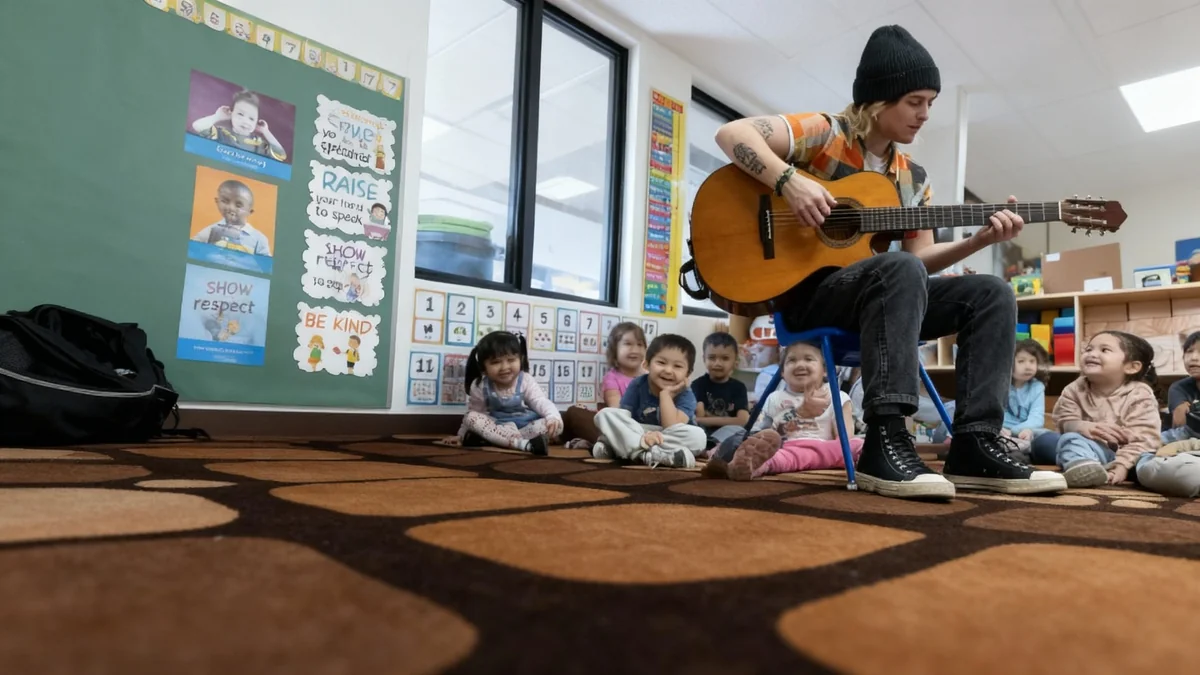
A major public education initiative in California, designed to provide free preschool for all 4-year-olds, is having an unintended effect on the state's child care landscape. New research indicates that the expansion of the transitional kindergarten (TK) program has contributed to the closure of 167 community preschools in Los Angeles County over the last four years.
While the state's program successfully enrolled an additional 13,000 four-year-olds in public schools, the county simultaneously lost 12,000 child care slots at private and community-based centers. This has created new challenges for families with younger children who now face fewer care options.
Key Takeaways
- Since 2020, 167 community preschools have closed in L.A. County during the rollout of universal transitional kindergarten (TK).
- The county lost 12,000 preschool slots for 3- and 4-year-olds, nearly offsetting the 13,000 new TK enrollments.
- A U.C. Berkeley study found a statistical link between TK enrollment growth and the rate of preschool closures.
- Wealthier neighborhoods have seen the largest increase in TK enrollment, while many lower-income families already had access to subsidized care.
- Preschools are struggling to pivot to infant and toddler care due to high costs, strict licensing, and staffing shortages.
An Ambitious Plan with Unforeseen Consequences
California's universal transitional kindergarten program was introduced as a landmark policy to expand access to early education. The initiative, which costs the state approximately $3.7 billion annually, became fully operational this year, making every 4-year-old eligible for a free spot in a public school setting.
However, a recent study from U.C. Berkeley researchers highlights a significant side effect. The data shows a sharp increase in preschool closures in L.A. County, from 92 between 2014 and 2019 to 167 between 2020 and 2024. The analysis suggests that as public schools absorbed 4-year-olds, community preschools lost their most financially viable age group, making it difficult to remain open.
"TK seemed like a sparkling idea with very few negatives," said Bruce Fuller, a UC Berkeley professor emeritus of education and public policy who co-authored the study. "But the downsides were not weighed carefully enough in retrospect."
The report found a direct correlation: areas in the county with the largest increases in TK enrollment were also the most likely to experience preschool closures. In some neighborhoods, the loss of child care capacity has outpaced the gains from TK.
A Net Loss of Care
In the Rolling Hills-Palos Verdes area, public schools enrolled 152 new TK students. During the same period, four local preschools closed, resulting in a loss of 316 child care spaces—more than double the number of TK seats gained.
The Struggle to Adapt
State officials had hoped that as community preschools lost their 4-year-old students, they would transition to serving infants and toddlers. This shift was intended to address a critical shortage of care for children under three. In L.A. County, licensed facilities can only serve 13% of working parents with infants and toddlers.
But for many preschool operators, this pivot is proving to be nearly impossible. Caring for younger children is fundamentally different and more expensive.
Obstacles to Transition
Several factors are preventing a smooth transition for these small businesses. Key challenges include:
- Stricter Licensing: Obtaining the required health and safety license for infant and toddler care is a complex process that can take up to a year.
- Higher Costs: State regulations require much lower teacher-to-child ratios. A single teacher can supervise 12 preschoolers but only three infants, drastically increasing labor costs.
- Staffing Difficulties: Many preschool teachers are not trained or interested in caring for babies. Nina Buthee, executive director of EveryChild California, described infant care as a "declining specialty."
- Facility Upgrades: Buildings often need expensive modifications to meet different fire codes and safety standards for younger children.
Annette Gladstone, owner of the Segray preschool program, said she has a waiting list for infants but finds the regulatory hurdles too burdensome to expand. "I would love to do it, but we just don’t love dealing with the process of what licensing puts you through," she explained.
A Surprising Enrollment Pattern
One of the stated goals of TK was to reduce educational disparities between children from different economic backgrounds. However, the U.C. Berkeley study revealed that the program's growth has been most significant in affluent communities.
Since 2021, TK enrollment has grown by 135% in the wealthiest quarter of L.A. County's ZIP Codes, compared to just 50% in the poorest quarter. Researchers suggest this may be because many low-income families already had access to long-standing free programs like Head Start.
Who Benefits Most?
Professor Fuller noted that middle and upper-middle-class families, who previously paid significant amounts for private preschool, are seeing the largest financial savings from the free TK program. "The quickest and biggest economic savings is felt by those upper middle-class families that had to pay for preschool," he said.
Preschools on the Front Lines
At Angelina Preschool, located near downtown Los Angeles, the impact is felt daily. Jacqueline Torres, an administrative director for the center, has watched her enrollment numbers drop from a high of 58 last year to 49 this year.
"Our 4-year-olds really have been disappearing," Torres said. She described how several families transferred to a public elementary school across the street at the last minute, leaving her with empty classrooms she has struggled to fill.
Torres believes the state did not provide community preschools with enough time or support to prepare for the shift. "It has really put preschools and school districts as almost competitors, when really I think TK should have been just another option," she lamented.
As the TK program continues to expand, experts like Nina Buthee predict more closures are on the horizon. "We haven’t seen the full impact of this," she warned. "Over the next year or so we will definitely see more programs closing." The situation illustrates the complex reality of implementing large-scale public policy, where a well-intentioned solution in one area can create new problems in another.