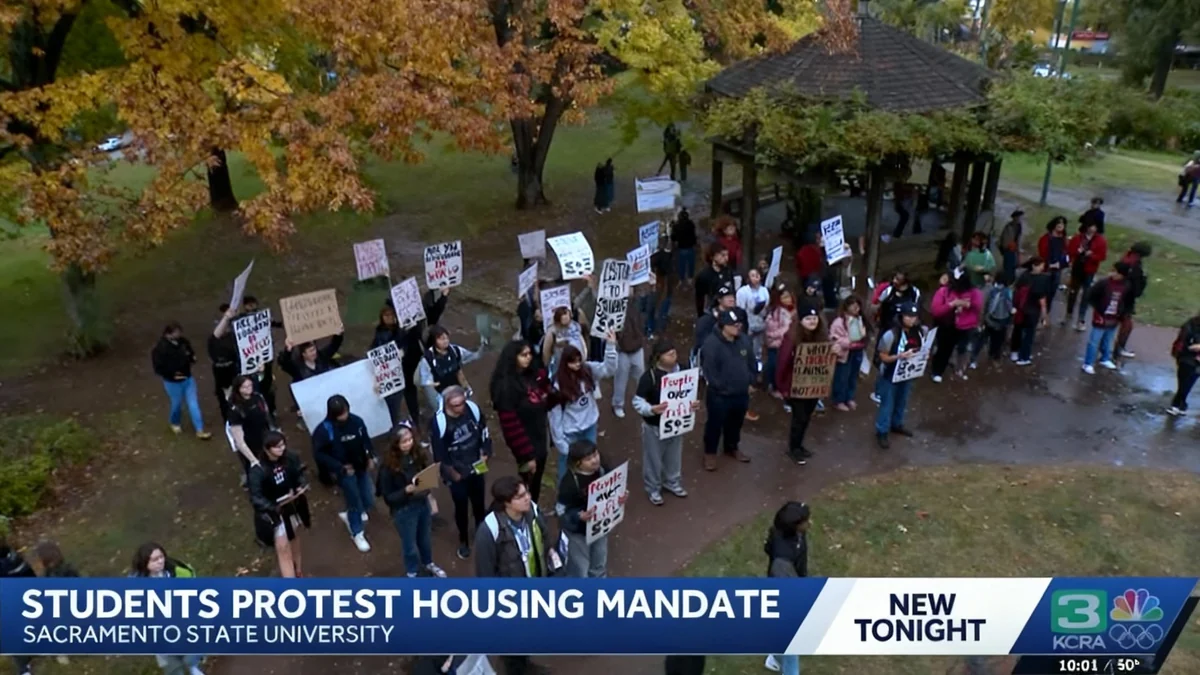

Students at Sacramento State are publicly opposing a new university policy that will require first and second-year students to live in on-campus housing. Citing concerns over high costs and the loss of personal freedom, dozens gathered to protest the mandate, which the university says is designed to improve academic success.
The policy, set to begin in fall 2026, marks a significant shift for the institution, which has traditionally served a large commuter population. While administrators point to data linking on-campus living with higher GPAs, students argue the financial burden outweighs potential benefits.
Key Takeaways
- Sacramento State will require first and second-year students to live on campus starting in fall 2026.
- Students are protesting the new rule, primarily due to the high cost of university housing and the removal of choice.
- The university defends the policy by citing research that shows on-campus students tend to have higher GPAs and graduate on time.
- Exemptions will be available for students with financial hardships, those living with family nearby, and other specific circumstances.
- The university is expanding its housing capacity with new and converted residence halls to accommodate the mandate.
Student Voices Rise Against Housing Mandate
On Thursday evening, the area outside the university library transformed into a platform for dissent. With signs and a bullhorn, students voiced their strong opposition to the administration's new housing requirement.
Emma Beck, the student who organized the demonstration, addressed the crowd, capturing the core issue for many. “I'm sure a ton of you know why we're here, and it's because we don't like the housing requirements,” she said.
Beck shared her personal experience, highlighting the financial pressures that students face. “I chose to live on campus my first semester here because it was convenient, but then I chose to move away because it was too expensive,” she explained. “So, there's two sides of the coin that they're not really seeing.”
“The benefits to living on campus are fantastic, where you have better access to all the resources here. But the financial burden just outweighs everything else.” - Emma Beck, Student Organizer
This sentiment was echoed by many attendees who feel the university is overlooking the economic reality for its student body. For them, the mandate removes a crucial element of control over their finances and living situations.
University Cites Student Success as Primary Goal
University officials frame the new housing policy as a strategic move to enhance student engagement and academic outcomes. The administration is working to shift Sacramento State's identity from a commuter campus to a more traditional residential university.
Nadine Kelly, the executive director of the university's housing services, explained the rationale behind the change. “I think that there's an opportunity to shift the direction and shift us to a residential destination,” Kelly stated. “There's something to be said about calling a place home.”
From Commuter Campus to Residential Destination
Historically, Sacramento State has served a significant number of students who live off-campus and commute for classes. This new two-year residency requirement represents a fundamental change in the university's model, aiming to create a more immersive and engaged campus community for undergraduates.
The university's position is supported by internal and national data suggesting a strong correlation between on-campus living and academic achievement.
“Students that live on campus tend to have higher GPAs, tend to graduate on time, and are having a different experience than students that live off campus,” Kelly added. The policy is intended to provide more students with this experience, which the university believes fosters a greater sense of belonging and connection to campus resources.
Details of the New Policy and Its Exemptions
The mandatory housing requirement will be phased in, applying to students beginning in the fall of 2026. Recognizing that a one-size-fits-all approach is not feasible, the university has outlined several exemptions.
A key exemption is for students who live locally with immediate family. For the fall 2026 term, this applies to students within a 50-mile radius of the campus. However, this distance will shrink to a 30-mile radius starting in fall 2027, tightening the requirement for future classes.
Who is Exempt from the Housing Rule?
Beyond local residency, students may qualify for an exemption if they meet one of the following criteria:
- Are age 21 or older by the first day of classes
- Are considered an independent student on the FAFSA
- Are active-duty military service members
- Are required to live at a job site (e.g., caregivers)
- Are participating in a study abroad program
- Have a disability or medical condition that cannot be accommodated in student housing
- Can demonstrate significant financial hardship
Despite these provisions, students like Beck remain concerned that the exemptions may not be broad enough to cover all who will be negatively impacted by the mandate's financial implications.
Expanding Campus Housing for a New Era
To prepare for the influx of residential students, Sacramento State is actively increasing its housing capacity. The university is not just implementing a new rule but also investing in the infrastructure to support it.
A new residence hall, Mt. Whitney Hall, is scheduled to open in fall 2026. This new building will provide 335 new beds specifically for first-year students, offering modern amenities designed to support their transition to college life.
Additionally, Riverview Hall will see changes. The university plans to convert some upper-division housing in this building to create an additional 150 single beds for the incoming classes subject to the new rule.
Alongside the physical expansion, the university plans to enhance its programming for first and second-year residents. The goal is to create tailored activities and support systems that build a strong sense of community and belonging, reinforcing the academic and social benefits the administration hopes the policy will achieve.
As the implementation date approaches, the debate continues. While the university focuses on long-term student success metrics, students remain focused on the immediate challenges of affordability and autonomy, ensuring this conversation will remain central to campus life.