
Recent school closures in Santa Rosa have led to significant overcrowding at remaining campuses, forcing acclaimed music programs out of dedicated classrooms and into makeshift spaces like cafeterias and libraries. Teachers report that the compromised learning environments are making it difficult to deliver quality instruction and are raising concerns about the future of the district's robust arts education.
Key Takeaways
- School consolidations in Santa Rosa have eliminated dedicated music classrooms at several elementary schools.
- Music teachers are now instructing students in non-traditional spaces, including cafeteria stages, libraries, and crowded general classrooms.
- The space constraints have resulted in damaged equipment and the removal of larger instruments from programs.
- Educators fear the disruption at the elementary level could negatively impact the district's renowned middle and high school music programs.
A Stage for a Classroom
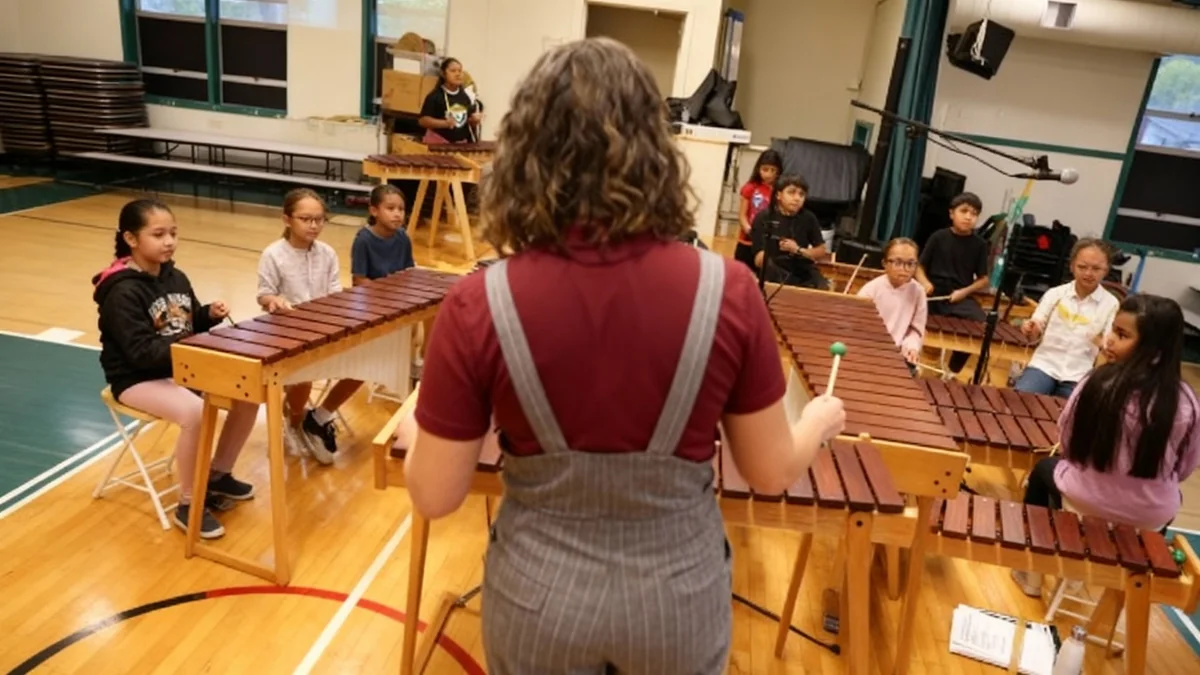
At Luther Burbank Elementary School, the sound of marimbas now fills the cafeteria during the day. Music teacher Irene Gilchriese arranges 14 of the large percussion instruments on the small, elevated stage for her fourth-grade students. This is their new classroom.
Previously, students learned in a dedicated music room. But after the district closed Albert Biella and Brook Hill elementary schools in June, Luther Burbank's enrollment swelled by 140 students, pushing the campus over its capacity and repurposing specialty rooms for core classes.
“The students have made comments to me about, ‘I miss the bass (marimba), I miss the baritone (marimba), our classroom…’ because they also feel the program has taken a hit,” Gilchriese said.
The new setup is precarious. Gilchriese had to remove the program's two largest instruments because they no longer fit. In September, two other marimbas fell from the stage, which has a three-foot drop. While they were not seriously damaged, the incident highlights the challenges of teaching in an improvised space.
Overcrowding by the Numbers
As of September, Luther Burbank Elementary had approximately 70 more students than it was designed to accommodate. In the first weeks of school, administrators converted the staff lounge into a kindergarten classroom to manage the influx.
A District-Wide Disruption
The situation at Luther Burbank is not an isolated case. Across Santa Rosa's seven remaining elementary schools, music educators are adapting to difficult circumstances. Some, like string teacher Pablo Robles, now travel between regular classrooms, wheeling large instruments through hallways and squeezing them between student desks.
“I can’t really do music stands, since all of the kids are sitting at their normal desks,” Robles explained. “Some of them are not facing me. When we’re doing music I need to be able to see everyone’s hands… so having them turn their whole chair around to look at me – it’s just been a huge mess.”
Lessons in the Library
At Steele Lane Elementary School, brass instrument lessons take place in the library. While it provides a space, teacher Nicholas Hodson notes the trade-offs. “If teachers have less access to library time, that can also be detrimental to students,” he said. The environment itself presents a challenge to creating an immersive musical experience.
Hodson, who rotates between multiple campuses, emphasized the importance of a dedicated space. “If I have a student that comes into a room and it doesn’t look like a music room, it’s hard to teach those students,” he added.
Choir teacher Beth Anne Turner described spending nearly three months teaching at Proctor Terrace Elementary in a room so crowded with 41 desks that she could barely move. The district eventually hired another teacher to alleviate the issue, but not before eight weeks of disruption for upper-grade students who were reshuffled into new classes.
Fears for a Storied Arts Program
Santa Rosa City Schools has long been praised for its commitment to arts education, guaranteeing music instruction for all students from first through twelfth grade. The district is home to several award-winning high school programs, including Santa Rosa High’s ArtQuest and Maria Carrillo’s jazz and orchestra ensembles.
The Foundation of Success
Strong elementary music programs are widely seen as the critical first step in developing the talent that feeds into the district's successful secondary school bands, orchestras, and choirs.
Teachers worry that the current instability at the foundational level could have long-term consequences. Lilly Chavez, a music teacher based at Hidden Valley Elementary, sees her role as providing students with their first formal exposure to music.
“To get kids ready for middle school band programs, choir, orchestra – it starts with us,” Chavez stated. She described teaching in multi-purpose rooms with constant interruptions from people walking through, making it hard for students to focus and engage.
“They leave elementary school without the full experience they deserve,” she said. Robles echoed this sentiment, observing that the constant distractions are taking a toll. “I can tell they’re starting to get very defeated.”
More Changes on the Horizon
The space crunch is expected to continue. The school board has already approved the closure of Steele Lane Elementary next June. Its student body of roughly 400 will be reassigned to other schools, including Hidden Valley, which is currently one of the few campuses under capacity.
Chavez anticipates that the influx of new students will once again put pressure on specialty classrooms at her school.
“(If) they’re planning on moving at least another 100 kids here, when we think about how many extra classrooms that is… some people are going to have to give up their spaces,” she noted. “Music teachers seem to be some of the first people to lose their rooms.”