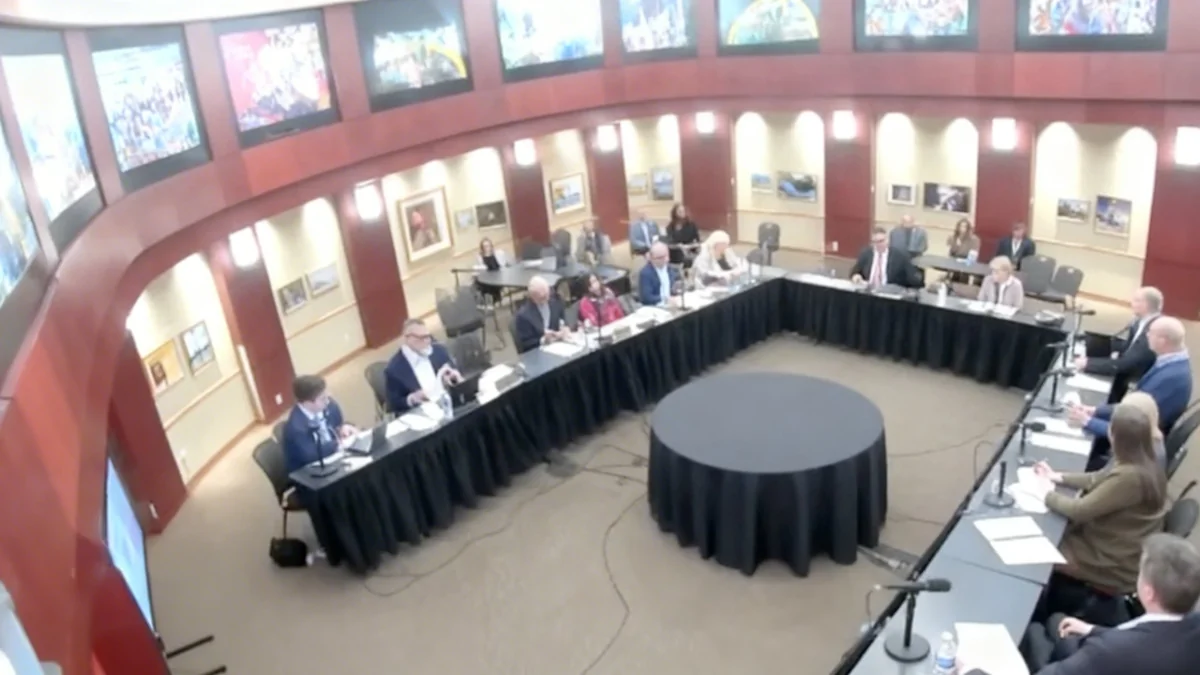





The Oklahoma Statewide Charter School Board has unanimously rejected an application for a publicly funded virtual Jewish charter school, setting the stage for a significant federal lawsuit that could challenge the separation of church and state. The decision, made on February 9, 2026, was immediately met with a promise of legal action from the school's backers.
The National Ben Gamla Jewish Charter School Foundation, represented by the religious liberty law firm Becket, announced its intention to sue in federal court. The foundation argues that the state's ban on publicly funded religious charter schools violates the U.S. Constitution's Free Exercise clause.
Key Takeaways
- Oklahoma's charter school board unanimously denied an application for the Ben Gamla Jewish Virtual Charter School.
- The school's foundation, led by former Rep. Peter Deutsch, plans to file a federal lawsuit, claiming the rejection is unconstitutional.
- The board cited a recent Oklahoma Supreme Court ruling that overturned the approval of a publicly funded Catholic charter school.
- The proposal has also faced opposition from some local Jewish community leaders in Oklahoma.
Unanimous Rejection Cites Legal Precedent
During its monthly meeting, the Oklahoma Statewide Charter School Board voted against the proposal from the National Ben Gamla Jewish Charter School Foundation. The proposed K-12 virtual school aimed to combine secular coursework with daily Jewish religious studies.
Several board members expressed that their decision was dictated by a recent Oklahoma Supreme Court ruling. In 2023, the board had approved the St. Isidore of Seville Catholic Virtual School, but the state's highest court later overturned that decision on constitutional grounds. An appeal to the U.S. Supreme Court resulted in a deadlock last year, leaving the state court's ruling in place.
Board member Damon Gardenhire acknowledged the legal constraints. "I am troubled by the fact that our hands are tied by the state Supreme Court decision, but I think we have to honor it, and it’s a very clear directive," he stated during the meeting.
Another board member, David Rutkauskas, echoed this sentiment, suggesting the outcome was not a reflection on the quality of the application.
“If I could have voted for this school today without being bound, I would have voted yes,” Rutkauskas said. “I think it would be great for the Jewish community and the Jewish kids to have this option of a high quality school.”
Immediate Vow to Escalate to Federal Court
The legal team for Ben Gamla wasted no time in responding to the board's decision. Becket, a law firm known for its work in religious liberty cases, confirmed its plan to challenge the state's position in federal court.
Eric Baxter, an attorney with Becket, specifically criticized Oklahoma Attorney General Gentner Drummond, who has consistently argued against the constitutionality of publicly funded religious schools. "Attorney General Drummond’s attack on religious schools contradicts the Constitution," Baxter said in a statement. "His actions have hung a no-religious-need-apply sign on the state’s charter school program."
The National Debate on Religious Charter Schools
The situation in Oklahoma is a focal point in a larger national debate over public funding for religious education. A victory for the Ben Gamla foundation in federal court could establish a new precedent, potentially allowing taxpayer-funded religious schools to operate in other states and significantly altering the traditional boundaries between church and state in American education.
The foundation is led by Peter Deutsch, a former Democratic congressman from Florida who is now a supporter of Republican President Donald Trump. Deutsch has previously established a network of nonreligious Hebrew-language charter schools in Florida and has identified Oklahoma as a key state for testing the legal framework for publicly funded religious education.
"Parents across the Sooner State deserve more high-quality options for their children’s education, not fewer," Deutsch stated following the vote. "We’re confident this exclusionary rule won’t stand for long."
Divisions Within the Local Community
While the legal battle lines are clearly drawn, the proposal has also revealed divisions within Oklahoma's own Jewish community. During the public comment portion of the board meeting, some local residents voiced their opposition to the school.
Dan Epstein, a Jewish resident of Oklahoma, argued against the use of public funds for religious instruction. "My religious education was entirely private," Epstein told the board. "My parents didn’t ask for anybody else to pay for it. They paid for it as part of dues to our congregation, and so I’m here today to express my opposition to the application of the Ben Gamla school."
Oklahoma's Jewish Population
Oklahoma is home to a relatively small Jewish community, with fewer than 9,000 residents identifying as Jewish. A significant portion of this community resides in the Tulsa area.
This sentiment was reinforced by a joint statement issued last month by the Tulsa Jewish Federation and other local Jewish leaders. They criticized the Ben Gamla foundation for not consulting with the established local community before submitting its application. "We are deeply concerned that an external Jewish organization would pursue such an initiative in Oklahoma without first engaging in meaningful consultation with the established Oklahoma Jewish community," the statement read.
Board member William Pearson cited this local opposition as a key factor in his deliberation. "My real concern is that I don’t see a grassroots effort from the Jewish community in the state of Oklahoma," Pearson noted. "What I have seen is the synagogues, both from Oklahoma City and Tulsa, come out in opposition to this, and I find that very interesting."
Anticipating the Lawsuit
The board's actions following the vote indicated a clear expectation of litigation. Immediately after denying the Ben Gamla application, the board approved a motion to hire outside legal counsel to handle the anticipated lawsuit.
Board Chair Brian Shellem made his prediction clear. "I can’t predict the future, but I would say, by all indicators, I would be shocked if there’s not a lawsuit filed by Friday," he commented.
The impending legal challenge will once again place Oklahoma at the center of the national debate over school choice, religious freedom, and the use of public funds for sectarian education. The outcome could have far-reaching implications for school systems across the country.