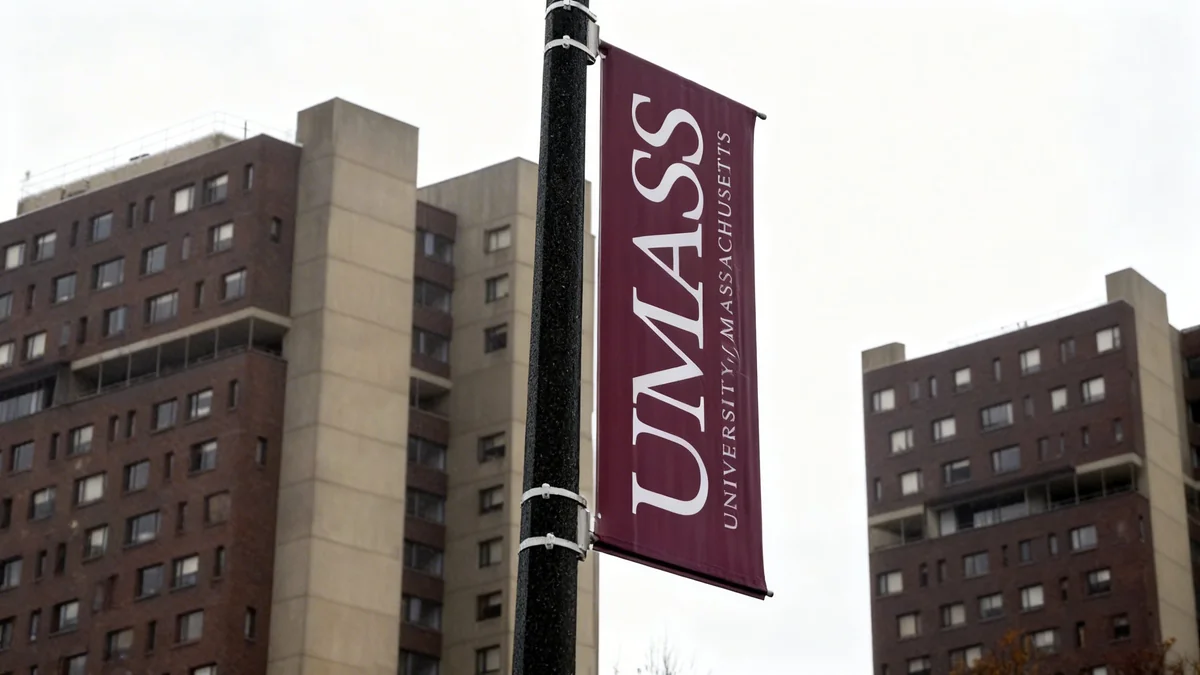



A Massachusetts judge has ordered the University of Massachusetts Amherst to immediately lift a one-year suspension imposed on a student involved in a pro-Palestine protest last fall. The court found the university likely violated the student's First Amendment rights, a decision hailed as a significant moment for free speech on college campuses.
The ruling, issued by Hampshire Superior Court Justice Jeffrey Trapani, grants a preliminary injunction allowing third-year student Kivlighan de Montebello to return to his studies while his lawsuit against the university proceeds. The decision centers on whether the student's actions during the protest constituted a "substantial disruption" to university activities.
Key Takeaways
- A judge ruled UMass Amherst likely violated a student's First Amendment rights by suspending him for protesting.
- The student, Kivlighan de Montebello, was suspended for a year following a Students for Justice in Palestine protest.
- The court issued a preliminary injunction, ordering the university to lift the suspension immediately.
- A key factor was a university official's own admission that the event being protested proceeded as planned without disruption.
The Protest and Suspension
The incident occurred last fall during a career fair hosted by the Isenberg School of Management in the UMass Amherst Campus Center. Kivlighan de Montebello, participating in a protest organized by Students for Justice in Palestine, used a bullhorn to lead chants against the presence of defense contractor Raytheon at the event.
University officials, including Associate Vice Chancellor Jeff Hescock, instructed protesters not to use amplified sound inside the building and to remain in a designated area. While the group complied with moving to the marked area, chanting continued. After being told to stop using the bullhorn again, Montebello engaged with students attending the fair before resuming call-and-response chants. Officials then directed the protesters to leave.
University's Disciplinary Action
Following the two-hour protest, the university's hearing board found Montebello in violation of three policies in the Code of Student Conduct: creating a disturbance, disruptive behavior, and failure to comply. The board's decision noted that Montebello acknowledged leading chants that could be heard inside the career fair.
Citing these violations and his prior conduct record, UMass Amherst imposed a year-long suspension, effective until December 31, 2026. This action prompted Montebello to seek legal recourse, leading to the recent court intervention.
A National Debate on Campus Speech
This case unfolds against a backdrop of heightened tensions on university campuses across the country. Debates over free speech, protest rights, and institutional neutrality have become flashpoints, with administrators balancing the protection of expression against the need to maintain campus order and safety.
The Court's Landmark Ruling
In a significant turn of events, Justice Jeffrey Trapani sided with the student. The court's decision to grant an emergency motion for a temporary restraining order and preliminary injunction was based on the likelihood that Montebello would succeed in his First Amendment claim.
"After oral argument on February 11, 2026, and review of the parties’ submissions, the court concludes, based on the record presently before the court, that Plaintiff has met the standard for a preliminary injunction with regard to his claim that the suspension violates his right to free speech under the First Amendment and Article 16 (of the Declaration of Rights)," Justice Trapani wrote in the ruling.
Defining 'Substantial Disruption'
A crucial element of the judge's reasoning was the legal standard for punishing student speech, which requires proof of a "substantial disruption." The court found the university's own evidence fell short of meeting this standard. In a striking piece of evidence, a statement from Associate Vice Chancellor Jeff Hescock proved pivotal.
A Decisive Statement: According to court documents, a key university official, Jeff Hescock, stated that despite the protest, "there were no disruptions inside the Campus Center auditorium, and the event proceeded as planned."
Justice Trapani highlighted this admission, noting it was "particularly helpful to Plaintiff’s case as a contemporaneous assessment by the University of the impact of the protest on the career fair." He concluded that chants being merely audible inside the event did not rise to the level of a substantial disruption.
Implications for Student Rights and University Policy
Advocates for free speech are celebrating the ruling as a major victory. Urszula Masny-Latos, the executive director of the National Lawyers Guild-Mass Chapter, which supported Montebello, emphasized the broader significance of the decision.
"This is a huge victory for student free speech," Masny-Latos stated. "The court confirmed what we argued from the start: UMass cannot suspend a student for exercising his constitutional right to peaceful protest. Universities that silence dissent should take notice."
The judge also addressed the potential harm to the student versus the university. He agreed that a year-long gap in Montebello's education constituted "irreparable harm." He dismissed the university's argument that allowing the student back could incite more protests as "speculative."
University's Response
When asked for comment, a spokesperson for UMass Amherst provided a brief statement. "While the university, as always, respects the outcome of the judicial process, it will not comment on active litigation," the spokesperson said.
As the case moves forward, the university is barred from dismissing Montebello, preventing him from attending classes, or imposing further sanctions related to this incident. The outcome of the full lawsuit will be closely watched by higher education institutions nationwide as they continue to navigate the complex landscape of student activism and constitutional rights.