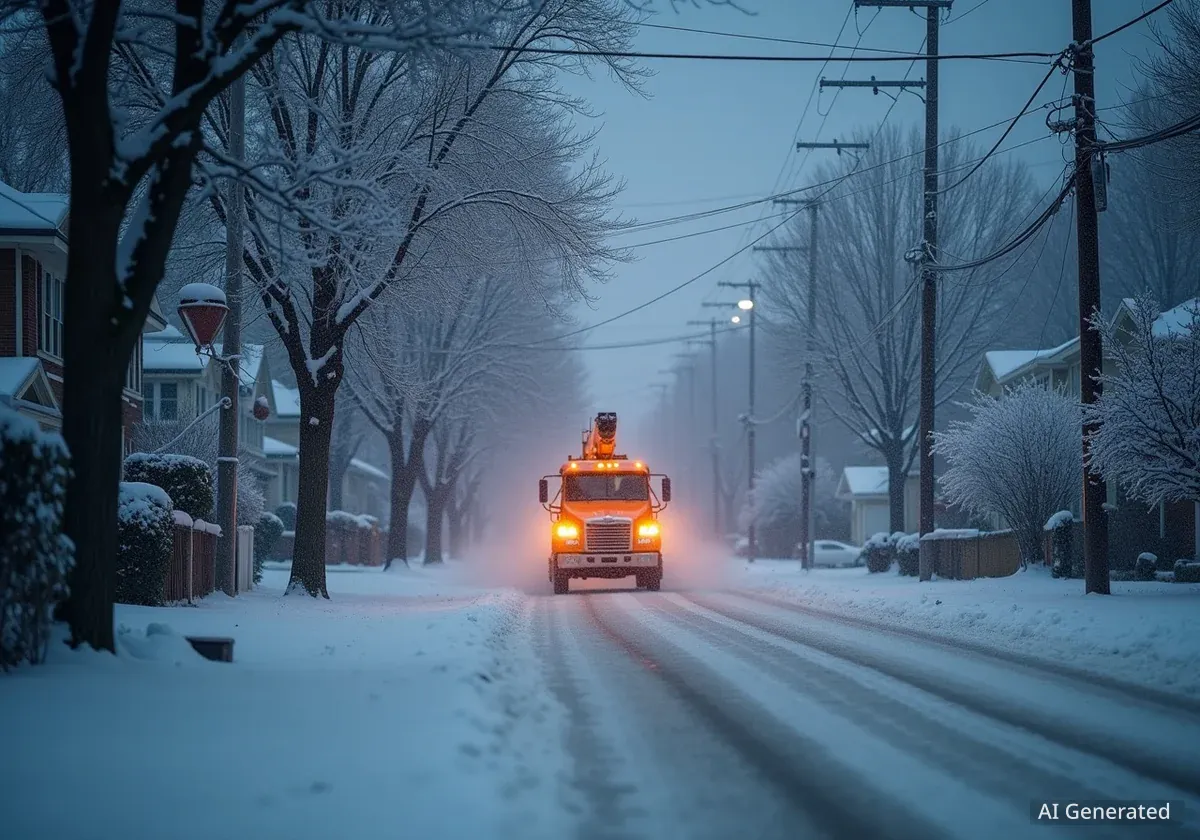




A messy winter storm swept across New England on Wednesday, delivering a mix of snow, freezing rain, and ice that created hazardous travel conditions. The weather system prompted widespread school closures and delays, caused thousands of power outages, and led to numerous traffic incidents across the region.
All six New England states were placed under winter weather advisories by the National Weather Service as authorities urged residents to exercise caution. While snow accumulations were not significant, a coating of ice made roads treacherous, leading to a day of disruption for communities from Maine to Massachusetts.
Key Takeaways
- A winter storm brought freezing rain, sleet, and snow to all six New England states on Wednesday.
- Dozens of school districts closed or delayed openings due to unsafe road conditions for buses.
- Thousands of power outages were reported, primarily in Maine and Massachusetts.
- Highway authorities in several states reported numerous vehicle accidents and spinouts, though no serious injuries were noted.
- Forecasters warn of another, potentially more severe, weather system expected over the upcoming weekend.
Schools Prioritize Safety Amid Icy Conditions
The primary impact of Wednesday's storm was felt by students and parents, as dozens of school districts canceled classes or implemented delayed starts. Officials cited the dangerous mix of precipitation as the main reason for keeping school buses off the roads.
In Brattleboro, Vermont, Green Street Elementary School operated on a two-hour delay. Parents like Rebecca Soubbel were seen walking their children, including her five-year-old daughter Eleanor Raymond, through the slushy streets to get to school safely.
The administration of Maine Regional School Unit 21, based in Kennebunk, issued a statement explaining their decision to close for the day. "With icy conditions forecast during both the morning and afternoon bus routes, ensuring the safety of our students and staff is our highest priority," the district announced.
Why Ice is More Disruptive Than Snow
Even a thin layer of ice, known as a glaze, can be more dangerous for travel than several inches of snow. Ice reduces friction between tires and the road surface to almost zero, making braking and steering extremely difficult. This is why school officials often react more cautiously to forecasts of freezing rain than to predictions of light snow.
Travel Disruptions Span the Region
The icy conditions created significant challenges for commuters and travelers. Highway authorities in Maine, New Hampshire, and Massachusetts reported a high volume of vehicle spinouts and minor accidents throughout the morning. Fortunately, no serious injuries were reported by late Wednesday morning.
Air travel was also affected. At least five New England airports, including Boston's Logan International Airport, were forced to deice aircraft before departure, a process that can cause delays. The thin but persistent layer of ice coated runways and plane surfaces, requiring careful treatment to ensure safe operations.
According to the National Weather Service, some areas received about a tenth of an inch of ice accumulation. While this is slightly less than the amount typically needed to cause widespread power outages from falling tree limbs, it is more than enough to create extremely dangerous road conditions.
In towns like Brattleboro, Department of Public Works crews were dispatched early, with sidewalk plows working to clear pedestrian pathways along main routes like Green Street.
Communities Cope with the Messy Weather
Residents across New England spent the day digging out and adapting to the wintry mess. In Vergennes, Vermont, Richard Hill was seen shoveling his driveway and sidewalk, a common scene throughout the region. Others found ways to make the best of the situation. Jackie Terry, a school bus driver in Vergennes, took time to build a large snow sculpture for her students to see along her route, bringing a moment of joy to a difficult day.
The storm also resulted in scattered power outages. A few thousand customers lost electricity, with the majority of the outages concentrated in Maine. Several hundred homes and businesses in Massachusetts were also affected.
Even daily routines like walking the dog became a challenge. In Brattleboro, Morgan Loeffler carefully navigated the snow-covered sidewalks on Western Avenue with her two dogs, Molly and Gia.
More Winter Weather on the Horizon
Meteorologists are warning that this is just the first round of hazardous weather for the week. Jerry Combs, a meteorologist with the National Weather Service in Gray, Maine, explained that the advisory was issued not for high snow totals but for the dangerous mix of precipitation.
"That was for the freezing rain and sleet and snow mixture. That makes the road conditions that much worse."
Combs noted that another, more complex weather system is expected to arrive Friday night. This storm could bring heavy rain, followed by a sharp drop in temperatures. This sequence creates the potential for a dangerous flash freeze, which could make travel treacherous again on Saturday and Sunday, with the possibility of more snow to follow.
Officials are advising residents to stay informed about the latest forecasts and prepare for more potential disruptions in the coming days.