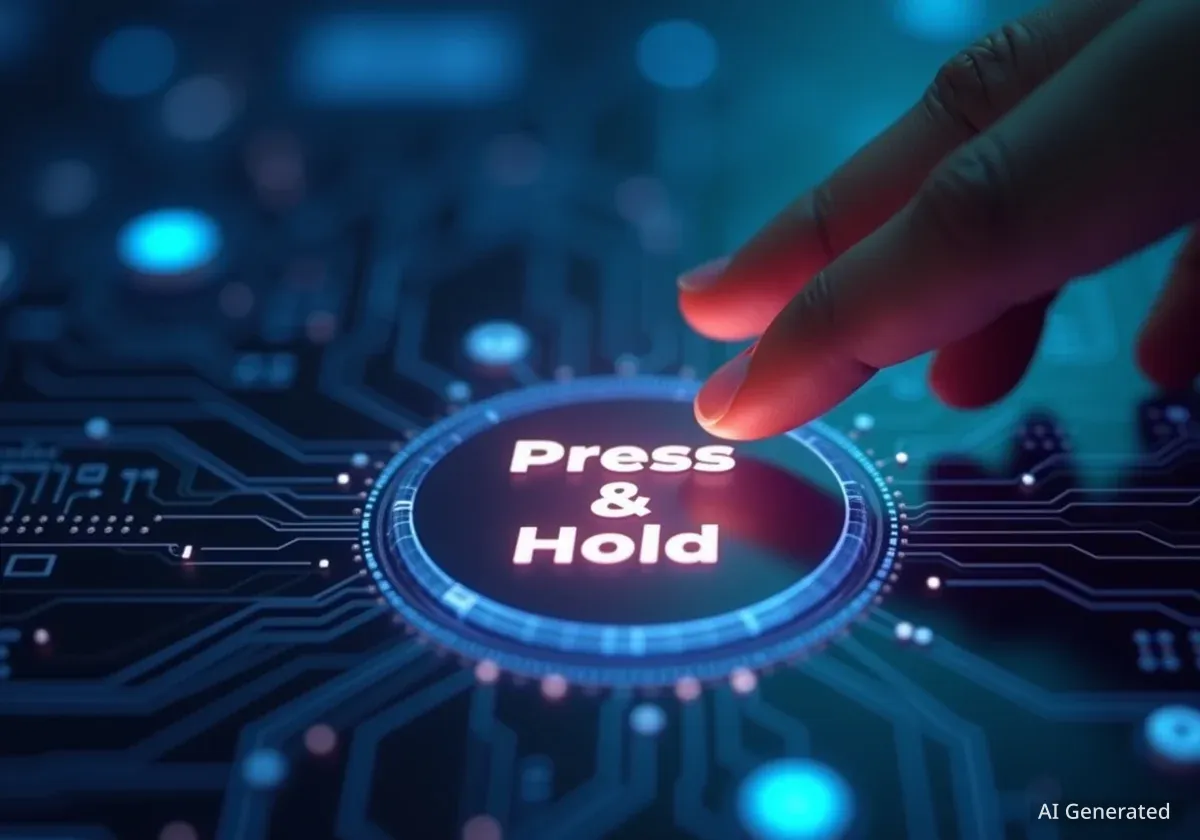

If you've browsed the internet recently, you may have encountered a new type of security check: a button asking you to "Press & Hold" to prove you are human. This method is part of a sophisticated new wave of technology designed to distinguish real users from automated bots, moving beyond the familiar distorted text and image-based puzzles.
These advanced verification systems represent the latest front in the ongoing battle between website operators and the increasingly complex bots programmed to scrape data, take over accounts, and disrupt online services. For users, it signals a shift toward more interactive, behavior-based security measures.
Key Takeaways
- Websites are adopting new human verification methods like "Press & Hold" to combat sophisticated bots.
- This technology analyzes behavioral biometrics, such as mouse movement, pressure, and timing, not just the click itself.
- The goal is to create a security check that is easy for humans but difficult for automated scripts to replicate.
- This evolution is driven by the failure of older CAPTCHA systems, which advanced AI can now often solve.
- The industry faces a constant challenge: balancing robust security with a smooth, accessible user experience.
The End of the Wobbly Word Puzzle
For years, the standard for proving your humanity online was the CAPTCHA, which stands for "Completely Automated Public Turing test to tell Computers and Humans Apart." Users were asked to decipher skewed letters and numbers, a task that was once simple for people but challenging for early computer programs.
However, as artificial intelligence and machine learning advanced, bots became adept at solving these puzzles. This led to the development of Google's reCAPTCHA, which often presented users with a simple checkbox labeled "I'm not a robot." If the system's background analysis of your cursor movement and browsing history was suspicious, you might be asked to identify objects like traffic lights or crosswalks in a grid of images.
Even these image-based tests are becoming less effective. Modern bots, powered by advanced image recognition AI, can now pass them with increasing accuracy. This has forced security providers to develop a new generation of tools that focus not on what you do, but how you do it.
How 'Press and Hold' Technology Works
The "Press & Hold" mechanism is a prime example of a security system based on behavioral biometrics. When a user interacts with the button, the system isn't just registering a simple click. It's collecting and analyzing a host of subtle data points in real-time.
Analyzing the Micro-Movements
A human user's interaction is rarely perfect. The way you move your mouse to the button, the slight tremor in your hand, the duration of the press, and the pressure applied (on touch devices) all create a unique signature. Automated scripts, by contrast, tend to be precise and direct, lacking the subtle imperfections of human movement.
Data Points Under Scrutiny
These systems can analyze dozens of variables, including:
- Cursor Path: Did the cursor move in a straight, robotic line or a slightly curved, natural path?
- Interaction Timing: How long did it take the user to locate and press the button?
- Pressure and Duration: On touchscreens, how much pressure was applied, and for precisely how long was the button held?
- Device Telemetry: Data from a smartphone's accelerometer and gyroscope can reveal if the device is being held by a person.
By comparing these behavioral patterns against a model of known human behavior, the system can make a highly accurate determination of whether the user is a person or a bot. This approach is designed to be a low-friction experience for legitimate users while presenting a significant hurdle for automated attackers.
The Escalating Arms Race Against Bots
The need for such advanced technology is driven by the sheer volume and sophistication of malicious bot traffic online. These are not simple spam bots anymore; they are complex programs designed for specific, often illegal, purposes.
"The digital landscape is in a constant state of cat-and-mouse between security platforms and bot developers," explains a cybersecurity analyst. "Every time a new defense is created, attackers immediately begin working to circumvent it. Behavioral analysis is the current frontier because it's fundamentally harder to fake human nuance."
Malicious bots pose a wide range of threats to businesses and consumers:
- Credential Stuffing: Bots use lists of stolen usernames and passwords from data breaches to attempt to log into thousands of websites automatically, leading to account takeovers.
- Scalping: High-speed bots buy up limited-stock items like concert tickets, game consoles, and sneakers the instant they are released, only to resell them at inflated prices.
- Content Scraping: Bots systematically copy entire websites, stealing proprietary content, pricing information, or user data.
- Denial of Service: Bots can overwhelm a website's servers with traffic, making it unavailable for legitimate users.
These activities have significant financial consequences, costing businesses billions of dollars annually in fraud, lost revenue, and infrastructure costs. This economic pressure is what fuels the investment in next-generation security tools like the "Press & Hold" check.
The User Experience Dilemma
While necessary, these security measures walk a fine line. If a system is too aggressive, it can frustrate and block legitimate users, a phenomenon known as a "false positive." A customer who is incorrectly identified as a bot and blocked from making a purchase is likely to take their business elsewhere.
The Importance of Accessibility
A major challenge for interactive security checks is ensuring they are accessible to all users, including those with disabilities. A "Press & Hold" task might be difficult for someone using assistive technology or who has a motor impairment. Security firms must provide alternative verification methods to comply with accessibility standards and ensure an inclusive internet.
The ultimate goal for security providers is to become nearly invisible to humans. The most advanced systems perform continuous risk analysis in the background, tracking user behavior from the moment they land on a page. In an ideal scenario, a legitimate user would never even see a security challenge. The interactive prompts only appear when the system's passive analysis detects suspicious activity.
The Future of Human Verification
The "Press & Hold" button is just one step in the evolution of digital identity. The future likely lies in systems that require no active participation from the user at all. Continuous authentication will monitor everything from your typing rhythm and speed to the way you hold your phone, constantly verifying your identity without interrupting your experience.
As we spend more of our lives online, the question of how we prove our digital humanity will only become more critical. For now, when you see that button asking you to press and hold, you are witnessing a small but significant moment in the complex, invisible war being fought to keep the internet safe and functional for real people.