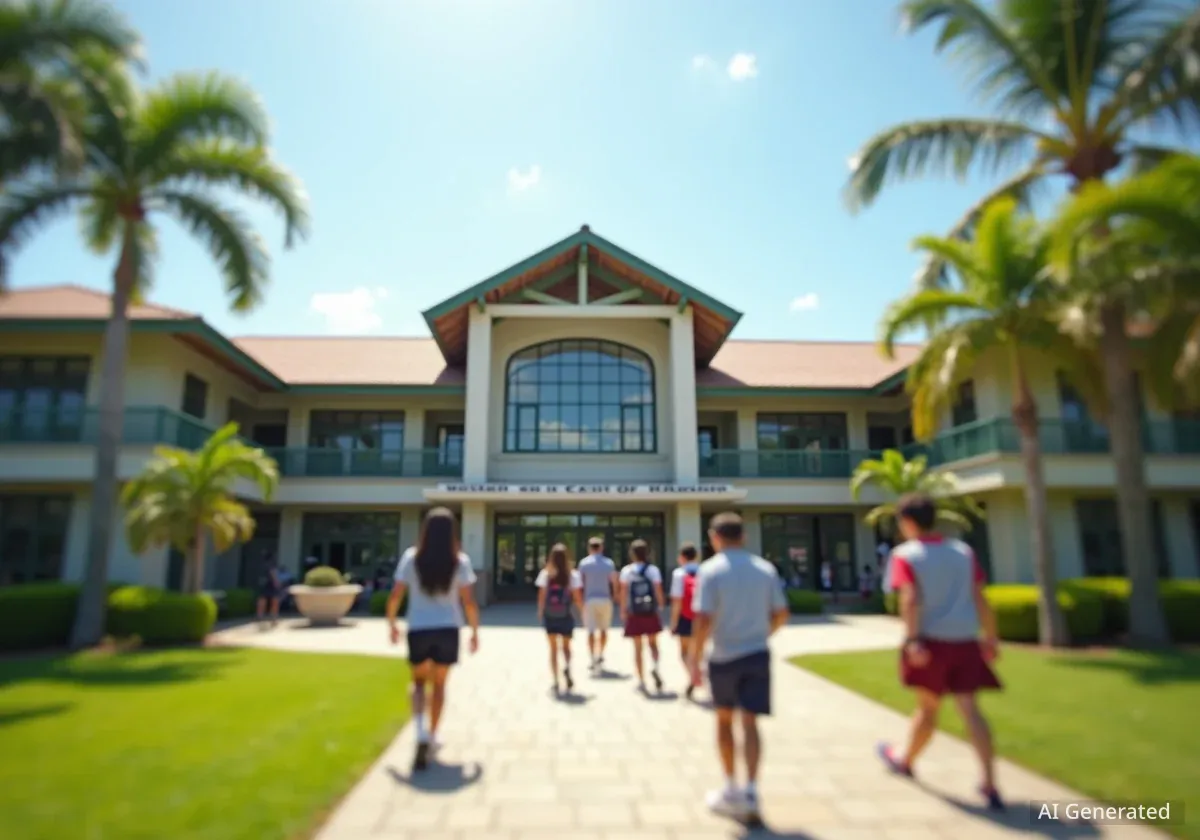




Kamehameha Schools, a prominent private school system in Hawaiʻi, has announced a landmark plan to eliminate tuition for all its students, beginning with the 2026-27 academic year. The decision, which is pending approval from the Probate Court, will affect approximately 5,400 students across its campuses and preschools.
The full cost of education will be covered by the institution's substantial $15 billion endowment, fundamentally changing the financial relationship between the school and the families it serves. School leadership described the move as a clarification of its founding mission rather than a change in policy.
Key Takeaways
- Kamehameha Schools plans to become tuition-free starting in the 2026-27 school year.
- The change requires approval from the Probate Court.
- The school's $15 billion endowment will cover all educational costs for its 5,400 students.
- The move is intended to align the school's operations with the philanthropic vision of its founder, Princess Bernice Pauahi Bishop.
A Historic Shift in Educational Funding
The announcement was delivered in a message from the Kamehameha Schools Board of Trustees and Chief Executive Officer Livingston Wong. This strategic shift will apply to all 30 preschools and three K-12 campuses located on Hawaiʻi Island, Maui, and Oʻahu (Kapālama).
For decades, families have paid tuition, although the school's endowment has heavily subsidized the actual cost. This new model removes the financial contribution from families entirely, a significant development for one of the state's largest educational institutions.
Current Tuition Structure (2025-26)
- Preschool: $2,800 to over $4,000
- Grades K-5: Nearly $5,700
- Grades 6-12: Nearly $7,000
- Boarding School: Over $12,000
The Role of the Endowment
The ability to make such a significant change stems from the school's powerful financial foundation. The endowment, valued at approximately $15 billion, has long been the primary source of funding for the institution's operations.
Even under the current tuition model, the endowment covers about 92% of the actual cost to educate each student. Furthermore, nearly 80% of students already receive some form of need-based financial aid, reducing their out-of-pocket expenses.
By moving to a tuition-free model, the school will simply have its endowment absorb the remaining 8% of costs currently covered by family payments.
Realigning with a Founder's Vision
School leaders emphasized that this decision is rooted in a deeper understanding of the will of Princess Bernice Pauahi Bishop, the great-granddaughter of Kamehameha I. She established the schools in 1884 to provide educational opportunities for Native Hawaiians.
"This is not a change in Ke Ali‘i Pauahi’s generosity. Her trust has always carried the primary responsibility to provide the resources needed for a Kamehameha Schools education. This is a clarification of this special relationship."
The message from trustees and Wong explained that the concept of tuition suggests a transactional relationship, which they believe no longer reflects the school's values.
They stated that responsibility at Kamehameha Schools is not derived from payment but from a sense of shared community and purpose. "It flows from aloha, ancestral connection and preparation," the message read.
A Legacy of Education
Kamehameha Schools was established by the will of Bernice Pauahi Bishop, the last royal descendant of the Kamehameha line. Her directive was to create schools to educate children of Hawaiian ancestry. The institution has since grown into a comprehensive system focused on Hawaiian culture-based education, serving thousands of students from early childhood through high school.
Navigating Modern Challenges
The move to eliminate tuition comes as the institution faces external legal scrutiny. In October, a lawsuit was filed by the Virginia-based group Students for Fair Admissions, which challenges the school's preference for admitting Native Hawaiian students as unconstitutional.
Kamehameha Schools has received widespread support from various organizations, including the Office of Hawaiian Affairs and the ACLU of Hawaiʻi. These groups have reaffirmed the unique political status of Native Hawaiians, which they argue justifies the school's admissions policy.
While the tuition announcement is not a direct response to the lawsuit, it reinforces the school's identity as a charitable trust operating to fulfill a specific, non-transactional mission. By removing the element of payment, the institution further distances itself from a conventional private school model and underscores its role as a legacy trust dedicated to a specific community.
The transition to a fully endowed educational model marks a new chapter for Kamehameha Schools, one that aims to more purely reflect the philanthropic spirit of its founding aliʻi.