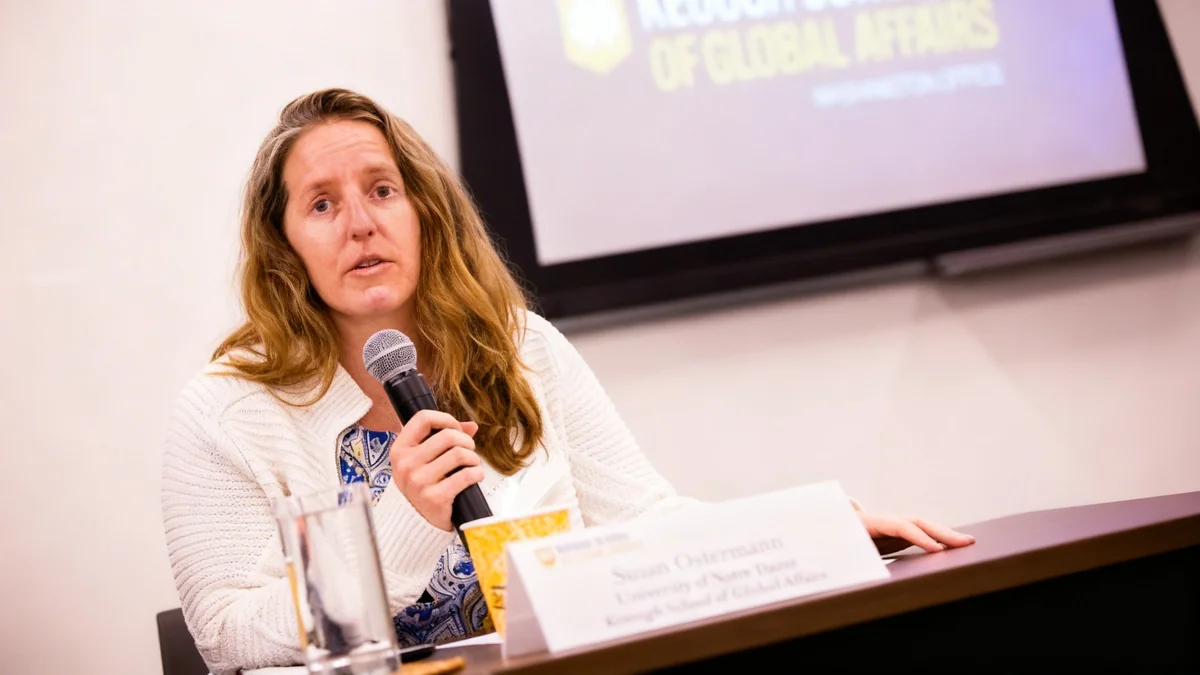
Professor Susan Ostermann has withdrawn from her appointment as the new director of the Liu Institute for Asia and Asian Studies at the University of Notre Dame. The decision follows weeks of intense criticism from religious leaders, campus groups, and faculty over her public advocacy for abortion rights.
The announcement was made Thursday morning in an email to students and faculty from Mary Gallagher, dean of the Keough School of Global Affairs. Ostermann, an associate professor of global affairs, will continue her teaching and research roles within the school.
Key Takeaways
- Professor Susan Ostermann has declined the directorship of Notre Dame's Liu Institute for Asia and Asian Studies.
- The decision follows backlash from Catholic leaders and campus organizations regarding her pro-choice advocacy.
- A planned student protest against her appointment is still scheduled to take place on Friday.
- Ostermann stated her withdrawal was to prevent the controversy from distracting from the institute's work.
Appointment Sparks Immediate Backlash
The University of Notre Dame first announced Professor Ostermann's appointment on January 8, with her term scheduled to begin on July 1, 2026. Almost immediately, the decision drew public opposition. Her history of writing articles in publications like the Chicago Tribune, where she voiced support for abortion rights, became a focal point for critics.
The pushback was significant and came from multiple directions. A group of 15 bishops and two cardinals publicly voiced their concerns, questioning the suitability of a vocal pro-choice advocate to lead an institute at a prominent Catholic university. This sentiment was echoed on campus by several student organizations and a number of professors who felt the appointment conflicted with the university's Catholic identity.
A Clash of Values
The controversy highlights a persistent tension within religiously affiliated universities like Notre Dame. These institutions often navigate a complex path, seeking to uphold their faith-based missions while also fostering academic freedom and a diversity of intellectual viewpoints. The debate over Ostermann's appointment brought this challenge to the forefront of the campus community.
Student organizers, including sophomore Luke Woodyard and junior Gabriel Ortner, planned a demonstration called the "March on the Dome" for the upcoming Friday to protest the appointment. The event was sponsored by multiple student groups who believed the university administration had made a serious error in judgment.
Ostermann Steps Down to Avoid Distraction
In the email from Dean Gallagher, Professor Ostermann provided a statement explaining her reasoning. She emphasized that her primary goal was to support the institute's mission and that she had not sought the leadership position but was honored to accept it.
"My only goal in accepting the Liu Institute Directorship was to serve as a steward for the Institute’s world-class faculty, students and staff," Ostermann wrote. "At present, the focus on my appointment risks overshadowing the vital work the Institute performs, which it should be allowed to pursue without undue distraction."
Ostermann also pointed to broader issues of campus climate and discourse. She suggested that the controversy revealed a need for more open dialogue at the university.
"It has become clear that there is work to do at Notre Dame to build a community where a variety of voices can flourish," she continued. "Both academic inquiry and the full realization of human dignity demand this of us."
In her email, Dean Gallagher expressed gratitude for Ostermann's willingness to serve and respected her decision. The university also released an official statement, saying, "We respect Professor Ostermann’s decision... She remains a highly valued member of our faculty, and we are grateful for her continued contributions as a scholar-teacher and member of the Notre Dame community."
Timeline of Events
- January 8, 2026: University announces Susan Ostermann as incoming director of the Liu Institute.
- Late January - February 2026: Backlash grows from religious leaders, faculty, and student groups.
- February 26, 2026: Ostermann's decision to decline the directorship is announced.
- February 27, 2026: Student-led "March on the Dome" protest is scheduled to proceed.
Protest to Continue Despite Withdrawal
Even with Ostermann's withdrawal, student organizers have confirmed that their planned protest will go on. They argue that the core issue extends beyond a single appointment and points to a deeper disconnect within the university's administration.
Luke Woodyard, one of the organizers, stated that the demonstration's purpose was always broader than just one person. He believes the event is necessary to send a clear message to the university leadership.
"This is great news, but although we won the battle, the war wages on," Woodyard said in a statement. "The fact that this pro abortion professor could ever be appointed signifies a much deeper Split between the students, deans, and administration."
He added that the march aims to ensure that future appointments are more closely aligned with what protestors see as the university's core Catholic values. "The spirit in which we ‘March on the Dome’ was never just [Ostermann], it was making sure nothing like this shocking appointment is ever tolerated at Notre Dame," he explained.
Future of the Liu Institute
With Ostermann stepping aside, the leadership of the Liu Institute for Asia and Asian Studies is now uncertain. The Keough School of Global Affairs has not yet announced its next steps for finding a director.
In her email, Dean Gallagher sought to reassure the community of the institute's stability. "The Liu Institute remains ... committed to supporting its faculty, students and staff as they carry forward this important work," she wrote.
The incident leaves Notre Dame's administration facing continued questions from both sides of the debate. While some are celebrating the outcome as a victory for the university's Catholic identity, others are concerned about what it means for academic freedom and the ability of faculty with diverse viewpoints to hold leadership positions on campus. Ostermann's decision has resolved the immediate conflict over her appointment but has intensified the underlying debate about the university's direction and values.