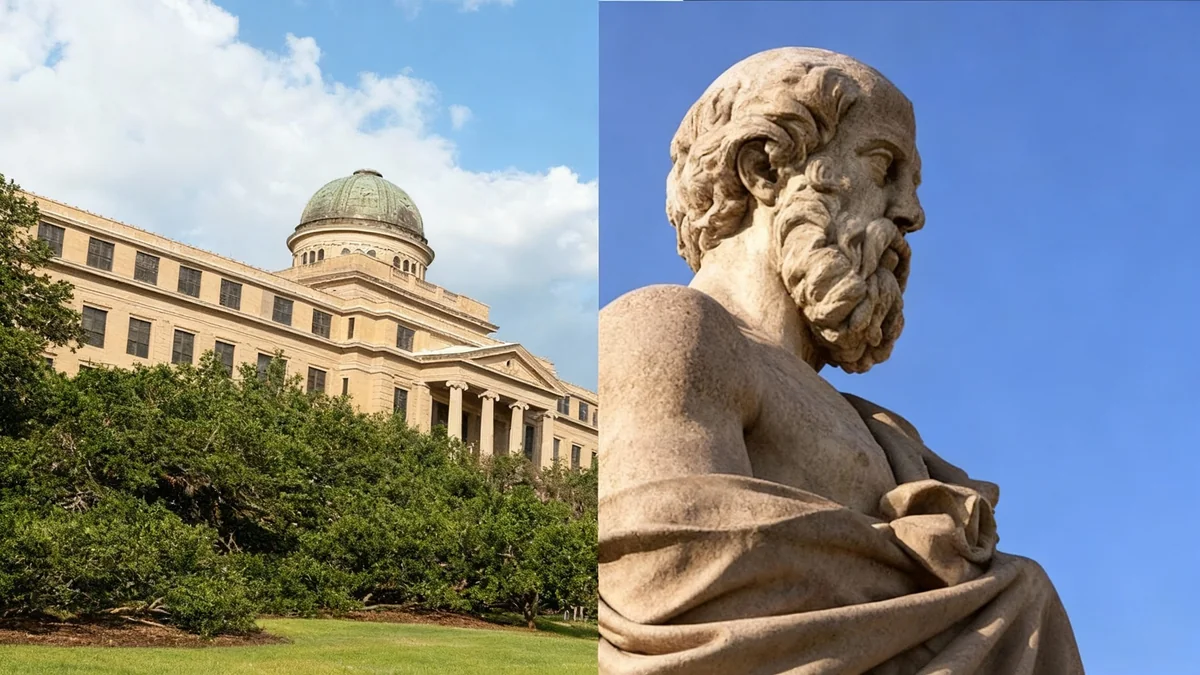
A directive at Texas A&M University to remove certain works by the ancient Greek philosopher Plato from a course syllabus has ignited a debate over academic freedom. University officials have raised concerns that the classical texts could conflict with new policies that limit discussions on specific topics within the core curriculum.
The controversy involves Professor Martin Peterson, who was instructed to revise his philosophy course to comply with system-wide rules restricting classroom discussions related to race, gender ideology, and sexual orientation. The move has drawn criticism from scholars who view it as an infringement on the fundamental principles of higher education.
Key Takeaways
- Texas A&M University has ordered a professor to remove parts of Plato's works from a philosophy course.
- The decision is based on new university policies restricting discussions on race, gender, and sexual orientation.
- Professor Martin Peterson, a 20-year veteran, was warned of potential reassignment for non-compliance.
- The incident is part of a broader national and international trend of re-evaluating classical texts in university curricula.
Directive Sparks Academic Freedom Debate
The issue came to light after Professor Martin Peterson received an email from Kristi Sweet, the head of the philosophy department at Texas A&M. The email instructed him to remove specific modules from his syllabus, citing potential violations of new university system policies.
According to Peterson, he was told that failure to alter his curriculum could lead to being reassigned to a different course. This directive has raised significant questions about the extent to which administrative policies can dictate academic content, especially in foundational subjects like philosophy.
"How can a serious research university censor philosophy professors and tell them it’s not okay to teach Plato? He is the founding father of the idea of a university, and now we can’t even read his books?"
Speaking as an individual faculty member, Peterson expressed his disbelief at the university's stance. He emphasized that Plato's works are central to the very concept of a university and academic inquiry. For over two decades of teaching, he has never encountered such administrative intervention.
A Veteran's Perspective
Professor Peterson noted that in more than 20 years of teaching philosophy, students have never complained about the content. He described them as consistently willing to engage with controversial ideas and found the justification for the ban to be unprecedented in his career.
The Broader Context of Curriculum Changes
The situation at Texas A&M is not an isolated event. It reflects a growing trend across the United States and other Western countries where classical texts, often referred to as the "Great Books," are being scrutinized through modern political and social lenses.
Legislative actions in states like Texas and Florida have sought to remove what some lawmakers deem "ideological" content from public education. These policies often lead to universities reviewing syllabi to ensure compliance, which can result in changes to long-standing curricula.
Legislative Influence on Academia
In Florida, regulations similar to those in Texas have prompted colleges to review their humanities courses. While there hasn't been an outright ban on figures like Aristotle or Plato, some professors have reported a chilling effect. They have described self-censoring or being advised by administrators to avoid certain Socratic dialogues, particularly those touching on social structures or communal living, to avoid falling foul of state law.
Historical Precedent and Modern Debates
Censorship in academia has a long history, dating back to theological bans in the 13th century. However, contemporary challenges to the classical canon arise from a different source: a polarized political environment. The pressure to modify curricula now comes from both legislative mandates and internal institutional movements aimed at "decolonizing" education.
International Trends in Classical Studies
The re-evaluation of classical thinkers is a global phenomenon. Universities in Europe and North America are also grappling with how to position these foundational texts within a modern, multicultural curriculum.
- SOAS University of London: In 2024, the university issued guidelines for decolonizing philosophy that were critical of focusing on Plato and Socrates, labeling their work as "armchair theorizing." The toolkit recommended shifting focus to thinkers from Africa, Asia, and Latin America.
- Reed College: Following student protests in 2018, the college in Oregon significantly overhauled its mandatory freshman humanities course. The curriculum, once heavily centered on Ancient Greece and Rome, was restructured to incorporate a more global perspective, reducing the time spent on classical Greek texts.
Beyond curriculum changes, many Classics and Greek studies programs face institutional pressures. Universities are increasingly merging or reducing these departments, often citing budget cuts and a push towards degrees perceived as more directly tied to employment outcomes.
The Student Experience
A key point raised by Professor Peterson is the reaction of his students, or rather, the lack thereof. He maintains that students have always been open to discussing the challenging ideas presented by Plato and other classical philosophers.
"Students never complain about Plato," Peterson stated. He finds the idea that these texts might make students 'uncomfortable'—and that this discomfort warrants a ban—to be a novel argument in his teaching experience. This perspective suggests a potential disconnect between administrative concerns and the actual classroom environment.
The ongoing situation at Texas A&M highlights a fundamental tension in modern higher education: balancing institutional policies and legislative mandates with the traditional principles of academic freedom and open inquiry. As universities navigate this complex landscape, the role of foundational texts like those of Plato remains a central point of contention.