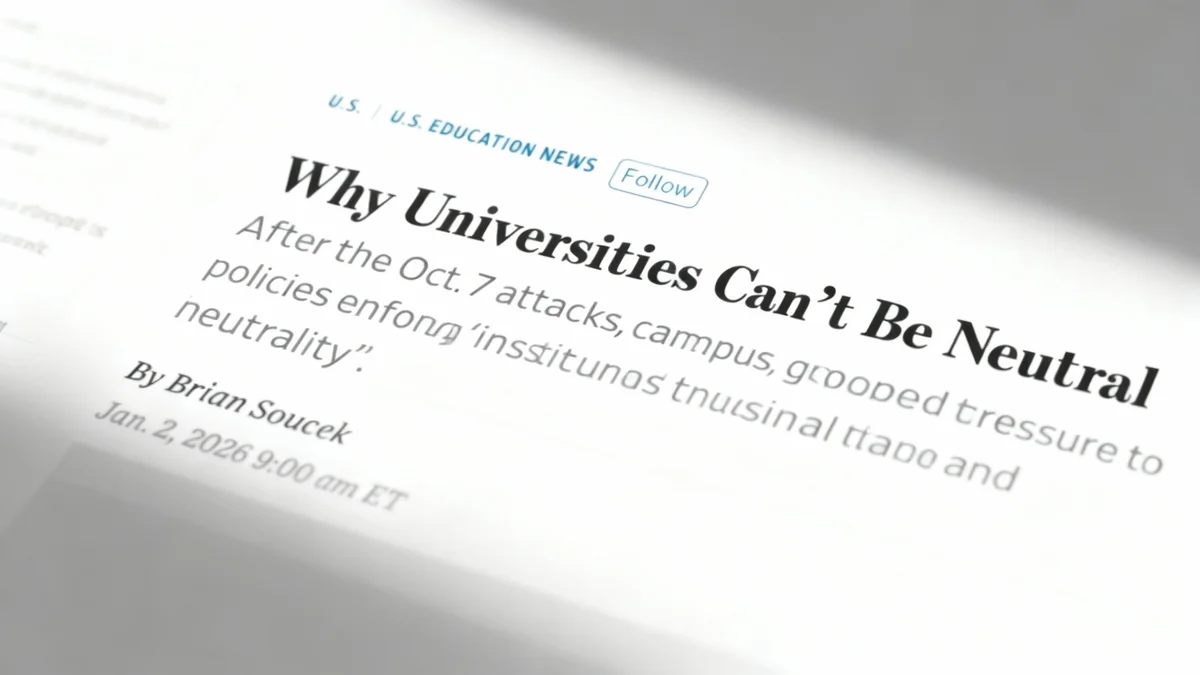

A growing number of American universities are adopting policies of institutional neutrality, pledging to refrain from making official statements on political or social issues. This movement, designed to protect free expression on campus, is now facing a significant challenge from critics who argue that true neutrality is an illusion and that silence itself is a political act.
The debate centers on a fundamental question about the role of higher education in a polarized society: should universities be impartial forums for debate, or should they take moral stands on the defining issues of our time? As more institutions grapple with this choice, the conversation is becoming increasingly urgent.
Key Takeaways
- Over 40 U.S. universities have adopted institutional neutrality policies, based on the University of Chicago's Kalven Report.
- Proponents argue neutrality is essential to prevent the chilling of free speech among students and faculty.
- Critics, like UC Davis law professor Brian Soucek, claim true neutrality is impossible, citing decisions on building names and mission statements as inherently political.
- The core disagreement lies in whether a university's silence on a controversial issue constitutes a political statement.
The Kalven Report and the Rise of Neutrality
The concept of institutional neutrality is most famously articulated in the 1967 Kalven Report from the University of Chicago. The report's central idea is that a university, to foster a climate of robust inquiry, must not take collective action on the political and social issues of the day. The goal is to avoid creating an official university orthodoxy that could intimidate or silence dissenting views within its community.
If a university officially endorsed a political candidate, for example, faculty members or students supporting an opponent might feel pressured to stay silent, fearing professional or academic repercussions. This, proponents argue, would undermine the university's core mission of promoting the discovery and dissemination of knowledge through open debate.
What is Institutional Neutrality?
Institutional neutrality dictates that a university and its official departments should not issue statements on political, moral, or ideological matters. This principle encourages individual members of the university community—students, faculty, and staff—to speak their minds freely, but prevents the institution itself from taking a side.
This does not mean universities can never speak out. The Kalven Report includes a crucial exception: an institution may take a stance on issues that directly threaten its ability to fulfill its core mission. For instance, the University of Chicago publicly opposed policies that would have impacted DACA recipients, arguing that preventing these students from attending would harm its mission to attract a diverse and talented student body.
According to the Foundation for Individual Rights and Expression (FIRE), 41 universities have officially adopted neutrality principles modeled on the Kalven Report. In contrast, 115 institutions have adopted the Chicago Principles on Free Expression, which focus on individual speech rights.
A Law Professor's Challenge to Neutrality
Despite its growing adoption, the principle of institutional neutrality is not without its critics. Brian Soucek, a law professor at the University of California, Davis, recently argued that the neutrality many universities are pledging is an "illusion." He contends that universities are constantly making value-laden decisions that amount to political statements, whether they intend to or not.
The Politics of Naming
Soucek points to the naming of buildings, schools, and professorships as one area where neutrality is impossible. He notes that UC Berkeley's law school removed the name "Boalt Hall" after discovering its namesake's anti-Chinese views. Similarly, the University of Chicago renamed its Oriental Institute and a chair named after Robert A. Millikan due to his ties to eugenics.
"In each of these decisions, Chicago, like other universities, did exactly what its former provost, Geoffrey Stone, said universities shouldn’t do: ‘make a statement about what is morally, politically and socially ‘right’—and wrong,'" Soucek argues.
Supporters of neutrality counter that these actions, while reflecting changing social values, do not function in the same way as official political pronouncements. They argue that renaming a building does not chill campus debate on historical figures or eugenics in the way an official university statement on abortion rights might silence pro-life students and faculty.
The Mission Statement Loophole
Soucek also claims that the Kalven Report's exception for mission-critical issues creates a loophole that makes neutrality meaningless. He suggests that universities define their missions differently, leading to different exceptions and, therefore, different political stances.
He argues that when a university chooses to remain silent on a controversial topic, such as transgender rights, it is making a powerful statement. "Staying quiet when trans students, faculty and staff are under attack isn’t silence in that case," he writes. "It is a loud expression that trans rights, and trans people, aren’t relevant to that school’s mission."
This perspective reframes the debate around the popular activist slogan, "silence is violence." It suggests that by not taking a stand, an institution is implicitly siding with the status quo or aggressors.
The Rebuttal: Is Silence a Statement?
Defenders of the Kalven Report strongly reject the idea that institutional silence is a form of speech. They maintain that Soucek fundamentally misunderstands the purpose of neutrality. The university's refusal to issue an official statement, they argue, is not an endorsement of any particular viewpoint. Instead, it is the very action that creates the space for all viewpoints to be debated openly and vigorously.
By remaining neutral, the university encourages discussion rather than squelching it. If the institution were to issue a statement on transgender rights, it would signal an official position, potentially making those with alternative or questioning views hesitant to speak up. The goal is not for the institution to have a mission focused on specific identity groups, but for its mission to protect the free inquiry of all its members.
Military Academies and Neutrality
Even institutions with highly specific missions, like military academies, embrace institutional neutrality. West Point and Annapolis do not endorse political candidates or policies because the military itself must remain apolitical, serving under any lawfully elected commander-in-chief. This demonstrates that a focused mission and political neutrality are not mutually exclusive.
Ultimately, the disagreement comes down to a philosophical divide. Soucek sees the university as an actor that cannot avoid making political statements through its actions and inactions. Proponents of neutrality see the university as a venue—a host for debate whose primary political act is to protect the conditions for that debate to thrive. They argue that the greatest threat to free expression on campus today is the pressure for institutions to take sides on every contentious issue.