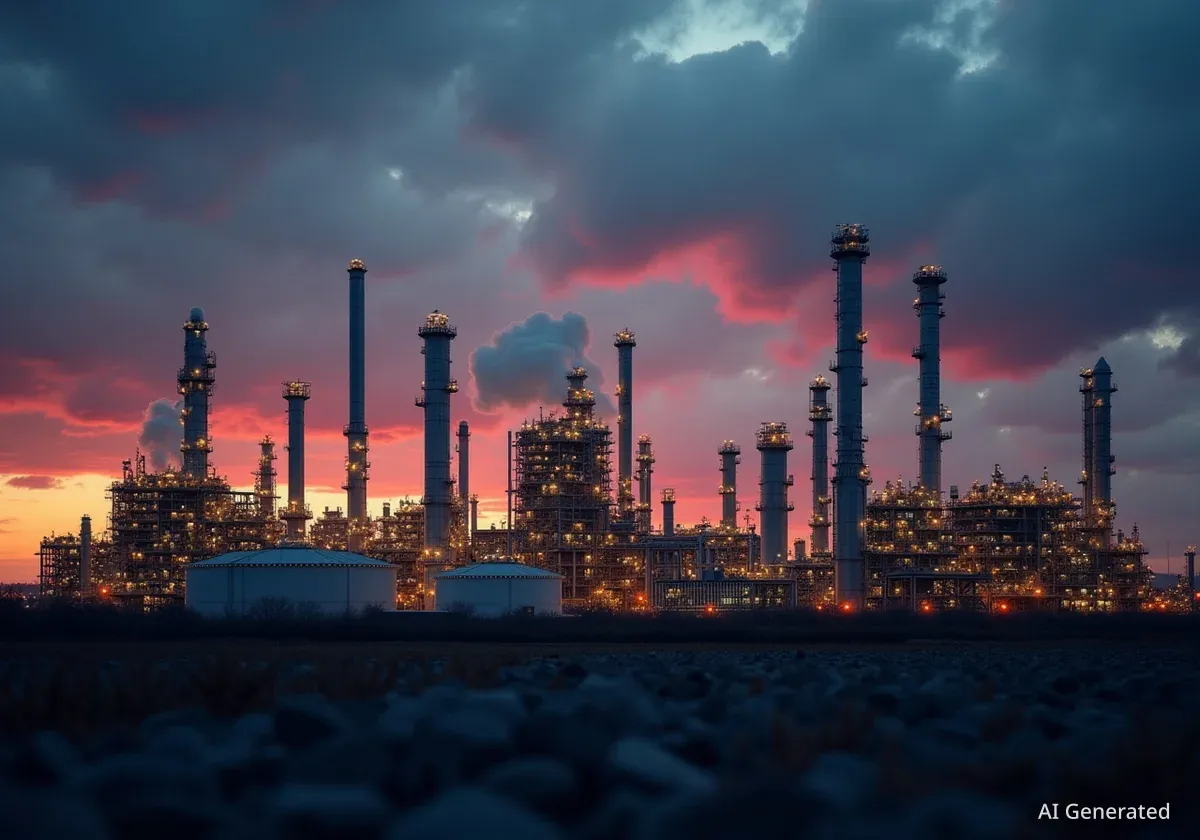


Global energy markets are rapidly transforming into a primary arena for geopolitical conflict, where access to resources and control over supply chains are being used as powerful tools of statecraft. Recent actions by the United States, the European Union, and China demonstrate a clear trend: energy policy is now inseparable from national security and economic warfare.
From intense pressure on Venezuela's oil exports to new carbon-related trade tariffs and escalating competition in the clean energy sector, nations are increasingly leveraging their energy positions to exert influence, secure strategic advantages, and challenge rivals on the world stage.
Key Takeaways
- The United States is intensifying its economic pressure campaign on Venezuela by targeting its oil sector, a critical source of revenue for the Maduro government.
- The European Union's Carbon Border Adjustment Mechanism (CBAM), which took effect on January 1, 2026, is creating new trade tensions by taxing carbon-intensive imports.
- Competition between the US and China has expanded into the clean energy sector, with both nations vying for dominance in technology, manufacturing, and investment in third-party countries.
- These developments signal a return to using energy as a strategic weapon, impacting global supply chains, market stability, and international relations.
Economic Pressure Through Oil Sanctions
The United States has recently escalated its long-standing campaign against the government of Nicolás Maduro in Venezuela, with a sharp focus on the nation's oil industry. This strategy aims to cripple the regime's main economic lifeline and force political change. In a significant move, two oil tankers were seized as part of broader sanctions targeting Venezuela's ability to export crude oil.
This aggressive posture reflects a calculated effort to use economic tools to achieve foreign policy objectives. According to analysis from Luisa Palacios and Edward Fishman, experts in energy markets and geopolitics, these actions are designed to isolate the Maduro government financially.
"Targeting the regime’s economic lifeline—oil—is a direct assault on its ability to operate. The effectiveness of this pressure campaign hinges on sustained, multilateral enforcement."
The situation in Venezuela is a prime example of how energy resources can become central to international disputes. On January 3, 2026, the US launched a military operation aimed at arresting President Maduro, a dramatic escalation that further destabilized the region's energy landscape. This direct intervention highlights the lengths to which nations will go when energy and politics intersect.
Context: The Venezuelan Oil Crisis
Venezuela, home to one of the world's largest oil reserves, has seen its production plummet over the last decade due to political instability, mismanagement, and lack of investment. US sanctions have compounded these issues, severely limiting the country's access to global markets and creating a significant impact on its economy.
The EU's Carbon Border Tax Reshapes Trade
Across the Atlantic, the European Union has introduced a groundbreaking policy that is already sending ripples through global trade networks. The Carbon Border Adjustment Mechanism (CBAM) officially came into force on January 1, 2026, fundamentally altering the rules for importing certain goods into the 27-member bloc.
CBAM requires importers of carbon-intensive products, such as steel, aluminum, cement, and fertilizers, to pay a tax equivalent to the carbon price set within the EU. The goal is to prevent "carbon leakage," where European companies might move production to countries with less stringent environmental regulations.
However, the policy is also viewed as a form of economic protectionism by some of its trading partners. Nations that rely heavily on exporting these goods to Europe now face a significant competitive disadvantage unless they adopt similar carbon pricing mechanisms. This has the potential to create new trade disputes and force a global reckoning on climate policy harmonization.
What is CBAM?
- Purpose: To equalize the price of carbon between domestic products and imports.
- Affected Goods: Initially targets iron, steel, cement, aluminum, fertilizers, electricity, and hydrogen.
- Implementation: Began its transitional phase in 2023, with full financial obligations taking effect in 2026.
- Global Impact: Pressures other countries to adopt carbon pricing to avoid the EU's border tax.
The implementation of CBAM is a clear signal that climate policy is no longer just an environmental issue; it is a central pillar of economic and trade strategy. According to energy policy scholars Trevor Sutton and Elliot Diringer, the emergence of trade policy at international climate talks indicates both a new frontier for cooperation and a potential source of significant friction.
US-China Rivalry Extends to Clean Energy
The strategic competition between the United States and China, once focused on traditional trade and technology, has now firmly expanded into the renewable energy sector. The global transition to clean energy is not just an environmental imperative but a multi-trillion-dollar economic opportunity, and both superpowers are maneuvering for dominance.
This rivalry is playing out across the entire supply chain, from the mining of critical minerals like lithium to the manufacturing of solar panels, wind turbines, and electric vehicle batteries. A recent commentary by Trevor Sutton, Sally Qiu, and Evelyne Williams highlights how US-China trade tensions are influencing clean energy investments in third countries, creating a complex web of alliances and dependencies.
The geographic distribution of clean energy manufacturing has shifted dramatically over the past decade. While China currently dominates many of these supply chains, the US is actively working to build up its domestic capacity and form partnerships with allied nations to reduce this reliance.
This economic conflict is being waged through tariffs, subsidies, and competing investment initiatives. Edward Fishman, an expert on economic statecraft, argues that a strategic, multilateral approach is necessary to effectively compete with China's long-term industrial policy.
The Race for Critical Resources
A key front in this energy competition is the supply of raw materials. For example, stabilizing volatile lithium prices is seen as essential for kickstarting American mining projects and securing a domestic supply chain for batteries. Experts like Kevin Brunelli have noted that a strategic lithium reserve is being considered as a potential solution to counter market fluctuations and ensure supply security.
As the world moves away from fossil fuels, the geopolitics of oil and gas are slowly being replaced by the geopolitics of critical minerals and clean technology. The nations that control these new supply chains will hold significant economic and political power in the coming decades.
The Future of Global Energy Politics
The convergence of energy, trade, and security is creating a new and unpredictable global landscape. The use of sanctions, tariffs, and strategic investments demonstrates that energy is once again being wielded as a powerful weapon in international relations. This trend is forcing nations and corporations to rethink their strategies, diversify their supply chains, and navigate an increasingly fragmented world.
Events like the upcoming Columbia Global Energy Summit on April 21, 2026, will provide a crucial platform for leaders to discuss these critical challenges. From the future of Russian gas exports amid geopolitical uncertainty to the role of geothermal and nuclear energy in powering a data-driven world, the path forward requires navigating a complex interplay of economic interests, national security concerns, and climate ambitions.