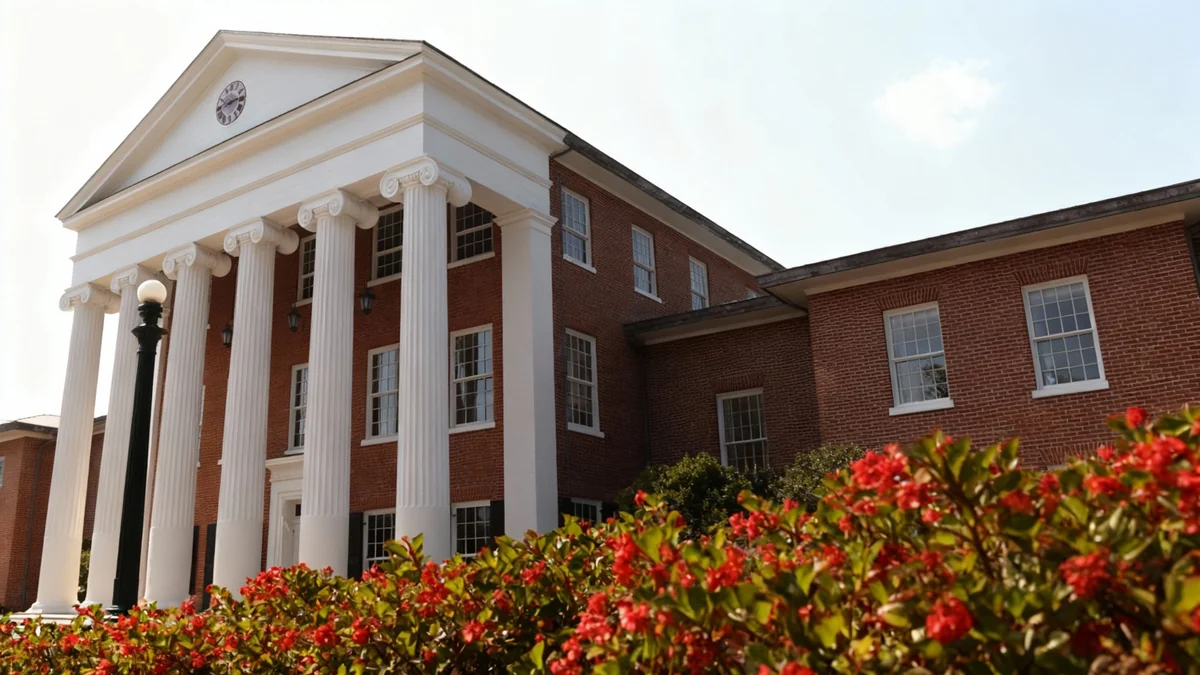


A former University of Mississippi employee has filed a federal lawsuit against the university's chancellor, Glenn Boyce, alleging her termination over a social media post constitutes a violation of her First Amendment rights. Lauren Stokes, who worked as an executive assistant, was fired in September after reposting a statement on her private Instagram account concerning the assassination of conservative activist Charlie Kirk.
The lawsuit, filed in U.S. District Court, argues that the university, as a public institution, unlawfully punished Stokes for engaging in constitutionally protected speech on a matter of significant public interest. The university has stated it does not comment on pending litigation.
Key Takeaways
- Lauren Stokes, a former Ole Miss employee, is suing Chancellor Glenn Boyce, claiming her First Amendment rights were violated.
- Stokes was fired after reposting a critical statement about the late conservative activist Charlie Kirk on her personal Instagram.
- The lawsuit argues that a public university cannot terminate an employee for expressing a viewpoint on a matter of public concern.
- Stokes's termination occurred shortly after Mississippi's State Auditor publicly questioned the university about her post on social media.
The Social Media Post and Termination
The controversy began on September 10, when Stokes reposted a statement from another user to her private Instagram account. The post was highly critical of Charlie Kirk, the CEO of Turning Point USA who had been assassinated earlier that day. It condemned his views on firearms, abortion, and race, concluding that the original author had "no prayers to offer Kirk or respectable statements against violence."
The repost quickly drew attention and criticism. According to the legal complaint, Stokes deleted the post and issued an apology within hours. However, the situation escalated rapidly. By 9 a.m. the following day, September 11, the University of Mississippi had placed her on administrative leave.
A Rapid Escalation
The timeline presented in the lawsuit highlights the speed of the university's actions. The decision to fire Stokes followed a public post on the social media platform X by Mississippi State Auditor Shad White, who questioned the university about the employee's post. Approximately one hour after White’s inquiry, Stokes was officially terminated.
Just 20 minutes after her dismissal, Chancellor Boyce released a public statement. While not naming Stokes directly, he confirmed a staff member was "no longer employed by the university" and described the comments as "hurtful" and "insensitive."
"The comments run completely counter to our institutional values of civility, fairness and respecting the dignity of each person," Boyce's statement read. "We condemn these actions..."
First Amendment at the Forefront
The core of Stokes's lawsuit is the argument that her speech is protected under the First Amendment. Her attorney, Allyson Mills, argued in the complaint that the university overstepped its authority as a state entity.
"A private employer might require its employees to conform to a point of view but the state acting through its public university cannot," the complaint states. It emphasizes that the speech, while potentially offensive to some, was related to a major national news event and did not originate with Stokes herself, but was a repost of another person's opinion.
Public vs. Private Speech
First Amendment protections for government employees can be complex. Courts often weigh the employee's right to speak as a private citizen on matters of public concern against the government's interest in maintaining an efficient workplace. Stokes's lawsuit contends her private social media activity falls squarely into the protected category.
The legal filing further argues that by firing Stokes, the university is effectively dictating what its employees are allowed to think on political and social issues. "The University says it gets to tell its employees what to think on matters of public concern," the complaint asserts. "The interests in freedom of speech, indeed of thought, are extraordinarily high here."
Wider Implications and Personal Consequences
The incident is part of a broader national pattern where individuals have faced professional repercussions for comments made online following Kirk's death. Journalists and educators in other states have also been fired after their social media activity was highlighted by conservative activists.
For Lauren Stokes, the consequences have extended beyond her job. She reports receiving death threats and bomb threats directed at the restaurant she co-owns with her husband. These threats were severe enough to force the business to close for two weeks, causing significant financial and personal distress.
Through the lawsuit, Stokes is seeking:
- Financial damages for her termination and related hardships.
- Coverage of all associated legal fees.
- A formal declaration from the court that Chancellor Boyce violated her constitutional rights.
The lawsuit was filed just over a week before a scheduled event at the University of Mississippi featuring Vice President JD Vance and Erika Kirk, Charlie Kirk's widow, hosted by Turning Point USA. The timing places the university's actions and the principles of free speech on campus under renewed scrutiny.