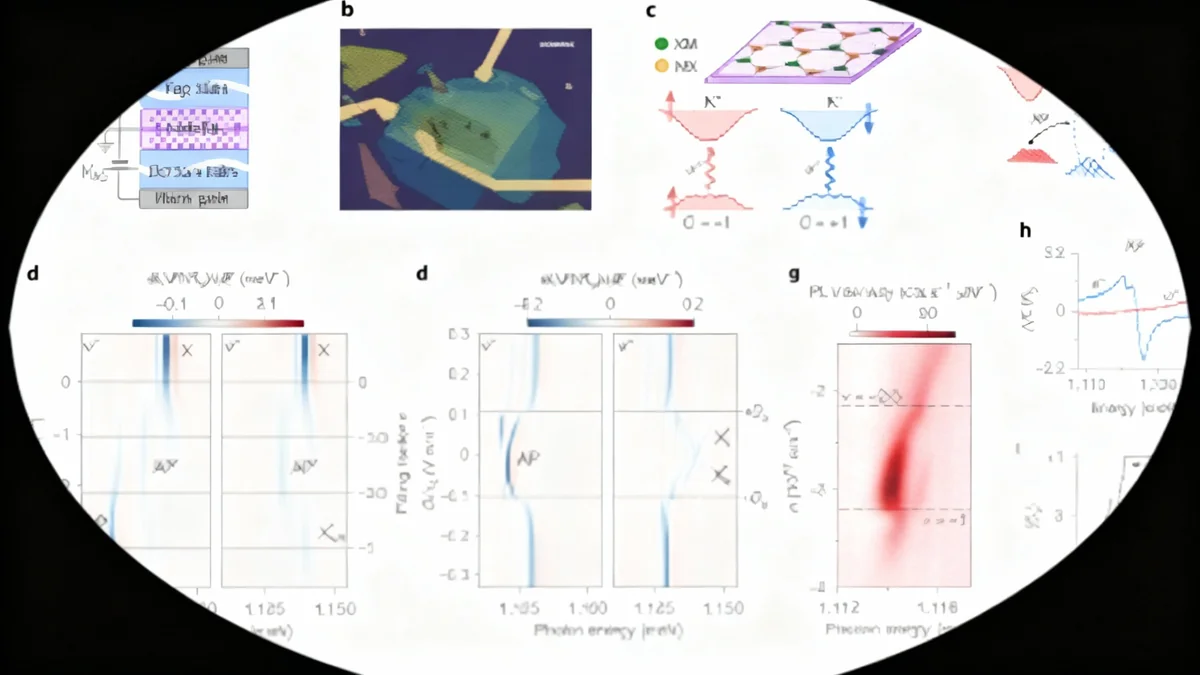

In a significant advance for quantum physics, an international team of researchers has successfully used light to control and switch the topological properties of a specialized two-dimensional material. The discovery, which involves manipulating quantum states at zero magnetic field, could pave the way for developing ultra-fast, light-based quantum computers and electronics.
The research team demonstrated the ability to dynamically reverse the spin-valley orientation of itinerant ferromagnets within twisted molybdenum ditelluride (MoTe2). This was achieved by applying circularly polarized light, effectively 'writing' and 'erasing' a quantum state without the need for traditional magnetic fields, a long-standing challenge in the field.
Key Takeaways
- Researchers used light to switch a fundamental quantum property, known as the topological Chern number, in a 2D material.
- The experiment was conducted on twisted molybdenum ditelluride (t-MoTe2), a material known for its unique electronic properties.
- This control was achieved at zero magnetic field, a crucial step for practical applications in quantum technology.
- The breakthrough could lead to the development of topological quantum circuits and more robust quantum computing hardware.
A New Frontier in Material Science
The foundation of this breakthrough lies in a class of materials known as moiré materials. These are created by stacking two-dimensional atomic sheets, like graphene or in this case, molybdenum ditelluride, and twisting them at a very specific angle. This twist creates a unique pattern, or superlattice, that dramatically alters the material's electronic behavior.
In twisted MoTe2, this structure gives rise to what are called flat valley-contrasting Chern bands. In simpler terms, it creates an environment where electrons behave in unusual and highly correlated ways, forming exotic quantum states. These states are described by a topological property called the Chern number, which is a key focus of the new research.
What is a Topological Property?
In physics, a topological property is one that is protected against small, continuous changes. Think of a donut and a coffee mug: you can stretch and deform the mug, but as long as you don't break the handle, it still has one hole, just like the donut. This robustness is highly desirable for quantum computing, as it could protect delicate quantum information from being lost due to environmental noise.
Previously, controlling these topological states often required powerful and cumbersome magnetic fields. The ability to achieve this control using only light represents a major simplification and a leap forward in manipulating quantum matter.
Flipping a Quantum Switch with Light
The core of the experiment involved shining a laser with circularly polarized light onto the t-MoTe2 sample. Circularly polarized light has a specific orientation, either spinning clockwise or counter-clockwise. The researchers discovered that by tuning the light to a specific frequency, they could directly interact with the material's quantum state.
This resonant excitation allowed them to reverse the material's 'spin-valley' orientation. This property is a unique degree of freedom for electrons in this material, similar to how magnetic spin works in traditional electronics but with added complexity and potential. By switching the polarization of the light from one direction to the other, the team could effectively flip this quantum property on and off.
A Non-Thermal Process
One of the most critical aspects of this discovery is that the switching is non-thermal. The light isn't simply heating the material to change its state. Instead, it's a direct, resonant interaction with the quantum system. This makes the process faster, more precise, and more energy-efficient, all crucial factors for building functional quantum devices.
The team, led by researchers from ETH Zürich, the University of Washington, and the National Institute for Materials Science in Japan, demonstrated that this optical control works for several different correlated phases within the material, including both ferromagnetic metals and Chern insulators. This versatility suggests the technique could be broadly applicable.
Implications for Future Technology
The ability to optically write and control topological states opens up exciting possibilities for next-generation technology. The primary application is in the field of quantum computing, where topological states are highly sought after for their potential to create fault-tolerant quantum bits, or 'qubits'.
Building Topological Quantum Circuits
One of the most promising outcomes of this research is the potential to create topological quantum circuits. By using light to 'draw' patterns of different topological states onto a single sheet of material, scientists could create pathways for information to travel without loss.
These pathways, known as chiral edge modes, would allow electrons to flow in only one direction along the boundary between two different topological domains. This is like creating a one-way quantum highway for information, which would be extremely efficient and resistant to errors.
- Faster Computing: Optical switching is incredibly fast, potentially leading to processing speeds far beyond what is possible with current electronics.
- Lower Energy Consumption: Controlling quantum states with light is more energy-efficient than using large magnetic fields.
- More Stable Qubits: Topological protection could solve one of the biggest challenges in quantum computing: qubit decoherence, where quantum information is quickly lost.
While the technology is still in its early stages, this demonstration of optical control over a topological order parameter is a landmark achievement. It provides a foundational tool that physicists and engineers can now use to explore and build the quantum devices of the future.