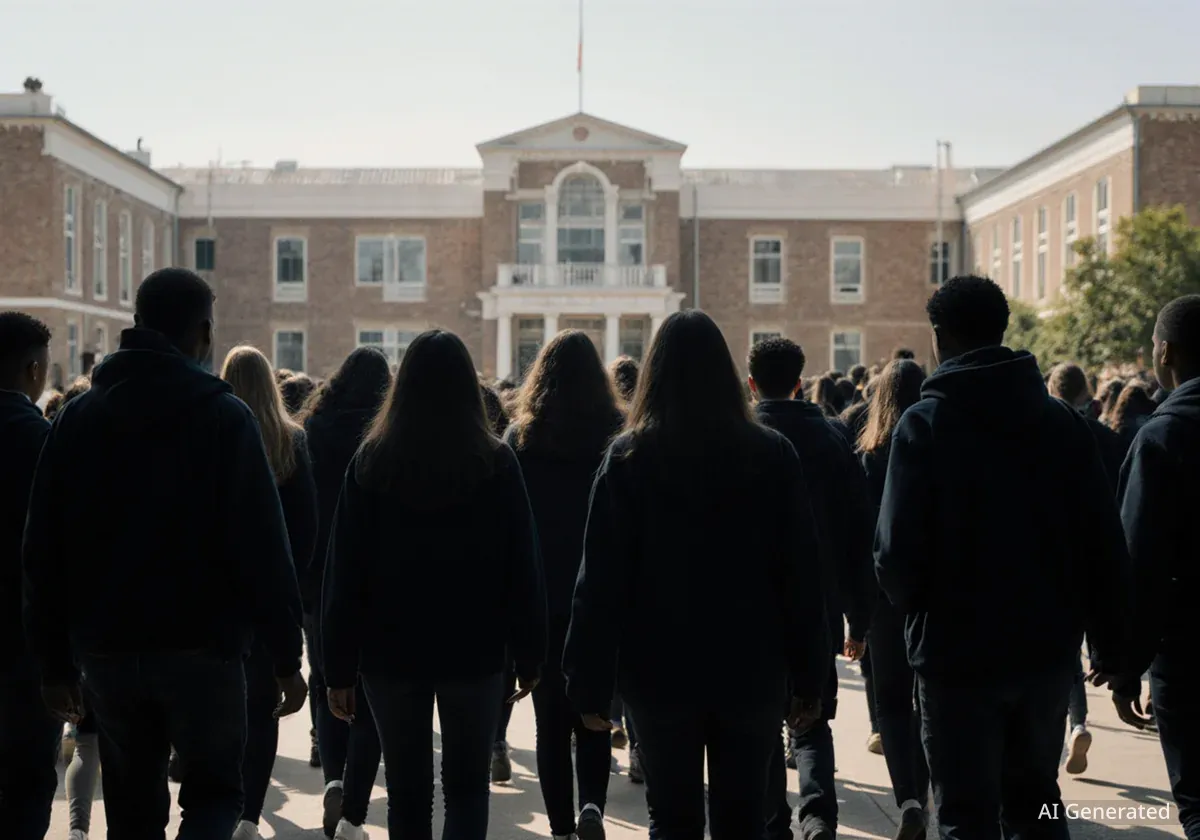
Hundreds of high school students across Spokane Valley and Liberty Lake walked out of their classes on Tuesday, staging a coordinated protest against federal immigration enforcement tactics. The demonstration saw approximately 400 students from four different high schools leave campus to voice their concerns over recent actions by U.S. Immigration and Customs Enforcement (ICE).
The walkouts at Ridgeline, Central Valley, University, and East Valley high schools follow a similar protest last week in Spokane and Mead, where over 750 students participated. Tuesday's event was entirely student-organized, with participants carrying handmade signs and chanting slogans to draw attention to family separations and recent fatal encounters involving ICE agents.
Key Takeaways
- Approximately 400 students from four Spokane Valley high schools participated in a walkout on Tuesday, January 20.
- The protest was organized by students to oppose aggressive ICE tactics and show solidarity with immigrant communities.
- The largest group, nearly 200 students, gathered at Ridgeline High School in Liberty Lake.
- School districts maintained a neutral stance, allowing the peaceful demonstrations while marking participants as absent.
- The student-led movement highlights a growing youth activism in the region, even in traditionally conservative areas.
A Coordinated Demonstration Across the Valley
The student protests were synchronized to begin around 11 a.m., coinciding with the lunch period for many. The largest gathering occurred at Ridgeline High School, where nearly 200 students marched off campus to the sidewalks of Country Vista Drive. The turnout surprised even the organizers, who had initially expected only a small group.
Using bullhorns and displaying signs, the students aimed to raise public awareness. Many passing drivers honked in support, though some expressed disapproval. Student speakers addressed the crowd, condemning what they described as the "injustice" of current immigration enforcement. They held a moment of silence for individuals who have died in ICE custody or during encounters with agents, including the recent case of Renee Good in Minneapolis.
"School doesn’t teach you what to believe in," said Armani Bain, a sophomore at Ridgeline High School. "So you have to go out there and show for yourself what it is you stand for, what it is you put up with."
The demonstration was a powerful display of youth engagement, planned and executed entirely by the students themselves. Organizers used social media over the weekend to spread the word, creating a network of communication between the different schools.
Voices of the Students
At each campus, students shared personal motivations for participating. Their reasons ranged from general principles of human rights to direct experiences within their communities. Many expressed a sense of duty to speak for those who cannot.
East Valley's Stand
At East Valley High School, about 50 students walked out. For some, the issue was deeply personal. "My friend had been here for five years, and they took his parents from him," said student Elisha Scamolla. "It’s not OK to deport people. We are taking a stance."
Organizers at East Valley noted the significance of protesting in an area that voted heavily for President Trump in the 2024 election. "East Valley is small enough that no one would think we would’ve done it. But that needs to be seen," said Sage Liskey, another student. "It’s gone too far. We need to stand up."
Community and Change at Central Valley
At Central Valley High School, a group of around 70 students gathered. Josephine Allen, a junior who helped organize the protest, spoke of creating a community for students who feel helpless or disconnected. One poignant sign read, "My mom fought for my future. Now, I’ll fight for hers."
Freshman Mack Benson highlighted the fear felt by immigrant families in the community. "In our community, we have immigrants and students who want to come to school and learn," he said, adding that they should not have to fear their parents being arrested while they are in class. "This says America is angry and our youth wants change," Allen added.
Official Response and School Policies
School administrators and local law enforcement were present at the demonstrations to ensure student safety but did not interfere with the protests. The Central Valley School District, which oversees Ridgeline, Central Valley, and University high schools, acknowledged the students' right to peaceful demonstration.
In a letter to families, East Valley High School Principal Ryan Arnold stated that the school did not endorse the walkout but recognized its limited authority to prevent peaceful student expression. "As a public school, we must balance student rights with our responsibility to maintain order and protect the rights of others," he wrote.
Discipline for last week's protests in Spokane Public Schools varied. Students who remained on campus generally received extended tardies, while middle school students who left campus at Sacajawea Middle School were given lunch detentions. The responses reflect an ongoing effort by districts to balance free speech rights with attendance rules.
The Motivation Behind the Movement
For many students, the decision to protest was a form of education in itself. Maggie Taninchev, a sophomore organizer at Ridgeline, cited her reading of Elie Wiesel's Holocaust memoir "Night" as a key inspiration. She drew parallels between the indifference described in the book and the current political climate.
"I realized this is not the time to be indifferent, as I see these parallels, and I see our government breaking the law and treating people inhumanely and taking away our rights," Taninchev explained. "This is not the time to be indifferent."
This sentiment was echoed by others who felt that missing a few hours of class was a small price to pay for taking a stand on a critical issue. As the students at Ridgeline returned to school after an hour, Armani Bain remarked, "I can still make up the work. You can’t make up for this if you don’t do it."
The walkouts in Spokane Valley signal a notable trend of civic engagement among young people in the region, who are increasingly using their collective voice to influence public discourse on national issues that directly impact their local communities.