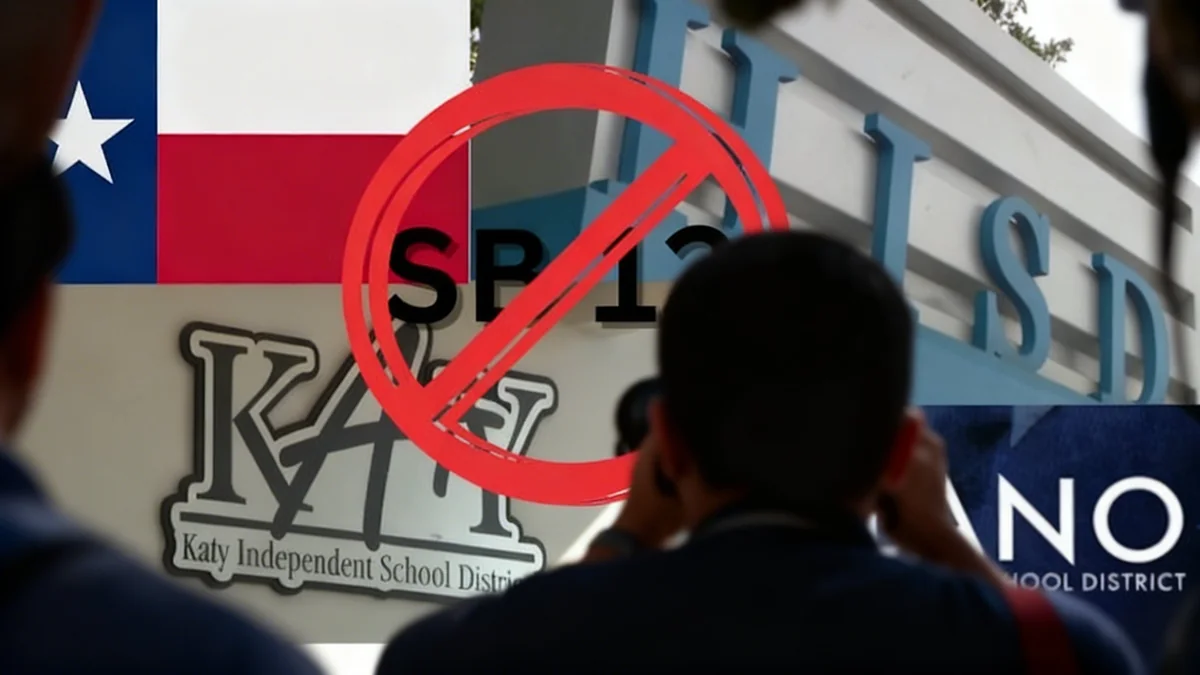





A federal judge has issued a temporary injunction preventing Houston ISD, Katy ISD, and Plano ISD from enforcing four key provisions of Senate Bill 12, a wide-ranging law concerning parental rights and school policies. The ruling, issued on February 21, 2026, creates a different set of rules for these three districts compared to the rest of the state while legal challenges continue.
The decision specifically targets sections of the law related to diversity, equity, and inclusion (DEI) initiatives, as well as policies on gender identity and sexual orientation. However, the majority of SB 12, particularly sections expanding parental access to student records, remains in effect for all Texas school districts, including the three named in the injunction.
Key Takeaways
- A federal judge temporarily blocked Houston, Katy, and Plano ISDs from enforcing four sections of Senate Bill 12.
- The paused sections relate to DEI programs, support for student social transitioning, and instruction on sexual orientation and gender identity.
- The remaining 23 provisions of SB 12, including expanded parental access to records, are still in effect statewide.
- All other Texas school districts must continue to enforce SB 12 in its entirety pending further court action.
What the Ruling Changes for Houston, Katy, and Plano Schools
The temporary injunction focuses on some of the most debated aspects of Senate Bill 12. For the immediate future, Houston ISD, Katy ISD, and Plano ISD are prohibited from enforcing the specific rules outlined in sections 3, 7, 24, and 27 of the law. This means these three districts are not currently required to implement certain restrictions that other districts must follow.
Paused Provisions in Detail
The court's order temporarily lifts several key requirements. Under the injunction, the three districts are not allowed to enforce the law's ban on:
- Diversity, Equity, and Inclusion (DEI) Initiatives: Schools can continue or reinstate DEI programs and related activities that were restricted by SB 12.
- Support for Social Transitioning: Teachers and staff are not prohibited by this state law from supporting a student who is socially transitioning, such as by using different pronouns or names.
- Instruction on Sexual Orientation and Gender Identity: The pause removes the law's specific restrictions on classroom instruction related to these topics.
- Student Clubs and Outside Organizations: The districts cannot use SB 12 to prohibit student clubs related to gender identity or sexual orientation, nor can they block outside organizations from assisting with these clubs.
This ruling creates a unique situation where policies on these sensitive issues can differ significantly between neighboring school districts. Officials from the affected districts have not yet issued detailed statements on how they will adjust their policies in light of the injunction.
Understanding the Scope of Senate Bill 12
Senate Bill 12 was signed into law on June 20, 2025, and was described by its authors as a measure to strengthen parental rights in public education. The law introduced comprehensive changes to how schools handle student records, health services, and sensitive curriculum topics.
The Purpose of SB 12
According to the bill's official caption, its purpose relates to “parental rights in public education, to certain public school requirements and prohibitions regarding instruction, diversity, equity, inclusion duties, and social transitioning, and to student clubs at public schools.” Supporters argued the law was necessary to increase transparency and give parents more direct oversight of their children's education.
The law consists of 27 provisions in total. While four are paused for the three districts, the other 23 remain fully enforceable statewide. These continuing requirements are a critical part of the legislation and significantly impact school operations and parent-school interactions.
What Parts of SB 12 Remain in Effect?
Despite the high-profile injunction, the core of SB 12 concerning parental rights and transparency is unaffected. All Texas school districts, including Houston, Katy, and Plano, must still adhere to the majority of the law's mandates. These unchanged provisions ensure parents retain significant oversight.
Key Unchanged Parental Rights
Parents across Texas continue to have expanded rights under SB 12. Schools are still legally obligated to:
- Provide Full Access to Records: Parents have the right to access all of their child’s records, including library checkout history, academic reports, counseling notes, and health information.
- Notify Parents of Health Changes: Schools must inform parents about any changes to a student’s mental, emotional, or physical health. The law also prohibits schools from encouraging students to withhold this information from their parents.
- Obtain Written Consent: Parental written consent is still required before a school can conduct psychological or psychiatric exams, offer certain health services, or provide instruction on human sexuality.
Filing a Grievance
If a parent believes a school is not complying with the active provisions of SB 12, they have a formal recourse. They can file a written complaint with their school district, typically using what is known as the FNG complaint process. The form requires a clear statement of the alleged violation, including dates and specific facts.
These remaining provisions underscore that the central theme of SB 12—parental involvement and transparency—remains the law of the land in Texas. The legal battle is focused on the specific provisions related to DEI and LGBTQ+ issues, not the broader parental rights components.
The Broader Legal and Social Context
The lawsuit against SB 12 is part of a larger, ongoing debate across the country about the role of public schools in addressing social issues. Supporters of the law, and similar legislation in other states, argue that it rightfully returns authority to parents, ensuring that a family's values guide a child's education and development.
Critics, however, contend that such laws can create a hostile environment for LGBTQ+ students and staff, limit open discussion in the classroom, and undermine the professional judgment of educators. They argue that DEI initiatives are essential for creating an inclusive environment for an increasingly diverse student population.
The federal judge's temporary injunction does not resolve these fundamental disagreements. Instead, it signals that the court believes the plaintiffs have a reasonable chance of succeeding in their argument that the four blocked provisions may be unconstitutional. The case will continue to proceed, and the temporary ban could be lifted or made permanent depending on future rulings.
For now, school administrators, teachers, parents, and students in Houston, Katy, and Plano find themselves navigating a different educational landscape than their peers in the rest of Texas. The ultimate outcome of this legal challenge will have significant implications for public education policy across the state.